Groovy & Wild Films from Around the World

Showing posts with label Horror Lit (series). Show all posts

Saturday, February 02, 2019

#MonthlyBookChallenge – January, 2019.

#MonthlyBookChallenge – January, 2019.

Well, this month has been crazy busy! Stephen King's and Richard Chizmar's utterly charming “Gwendy's Button Box” seems like so long ago... purchased at an Indigo Boxing-Day Sale, this was the first book of the month for me. I went on to read, upon recommendation (and to which I have fully appreciated this recommendation), “The Bullet Journal Method” – wannabe organizers, get ready to change our life! And I finally got through – or, rather, I finally gave my undivided attention to – Philip Kerr's Nazi-noir-thriller “Prague Fatale”, based around the novels of Agatha Christie, and quite good fun to read, too. I also finally introduced myself to Thomas Pynchon after years of curiosity, thanks to a local library sale, with “The Crying of Lot 49”, a very weird but electric hippie-underground-caper. I have come to believe that only Pynchon can make a caper story completely un-caper-like, as he'd apparently also created the ultimate un-noir noir thriller “Inherent Vice”. I think I'll track that one down next. I also, finally (and surprising that I waited this long?) checked out the writings of the Marquis de Sade, “The Mystified Magistrate” and “Philosophy in the Bedroom”, the latter book being of several catalystic influences for the films of Jess Franco. Lastly, I read JB Priestley's “An Inspector Calls”, a play that was brought to my attention during these strange times of social shaming, bullying, and the suicides of young people (please check out Jon Ronson, by the way, if your interest is piqued); Priestley's play is from 1912, if memory serves, but is in context now a chilling prediction of the power social media, and specifically social media shaming, can have on people. “An Inspector Calls” is still in print today and has also been adapted into a graphic novel, exemplifying its literary relevance today, over a hundred years later. 

--V.


Wednesday, January 02, 2019

3 Books a Month – December (Holiday Reading)

I'm seriously impressed that we've been able to continue this #3booksamonth challenge going since the spring of 2018 – but here we are, and Happy New Year to everyone! My first book of December seems so long ago it could've been months ago. It was Peter Straub's brilliant and deeply insightful serial killer novel “Koko”, and for those of you who think you may know Straub's name, I urge you to think about “The Talisman”, his famous collaboration with Stephen King. But “Koko” is one of the best horror novels I've read in a long, long time. It's a very rich book for the horror genre, but the picture it ultimately paints is vast as well as deep, weaving the mystery of the killer and those who attempt to find him or her with or without the help of the police, with the backdrop of the horrors of the Vietnam war, bot on and off the battlefield. It's complex and brilliant. Following that, I took a trip back to Dean Koontz land with his old horror/sci-fi/suspense novel “Lightning”, which I found at a Value Village while
searching for a different book entirely. “Lightning” is exciting and satisfying, as with most of Koontz' early genre works, it's entire out-of-reach in terms of identifiable protagonists, but you do love his good guys, regardless, they're just so perfectly perfect. Like how fudge is sweeteningly sweet. But, hell, who doesn't like fudge, right? A novel like “Lightening” is what happens when a movie like “The Terminator” inspires a time-travel scenario in another creative writer.


The third book (of four this month for me, all just barely squeezed in by New Year's Day) is actually an amazing, inspiring self-help book titled “You Are a Badass at Making Money”, which was recommended to me by Nicki, who said, “You're almost there, sweetie, I think you need to read this”. Whether you think you need to read something like this or not, it is a good, inspiring read by an inspired author. I closed the year out with the 1926 short novel “Dream Story” (aka “Traumnovelle”) by author Arthur Schnitzler, which was the basis for one of my go-to Christmas films, Eyes Wide Shut, by Stanley Kubrick. In the closing credits of Eyes Wide Shut it states that Kubrick's film was “Inspired by” the book... No, it was wholly based on Schnitzler's material, even using dialogue lifted directly from the book for the film version. All books this month are highly recommended (as usual). 

--V.


Sunday, December 02, 2018

3 Books a Month – November (Fall Reading... Still in the Mood for Horror)

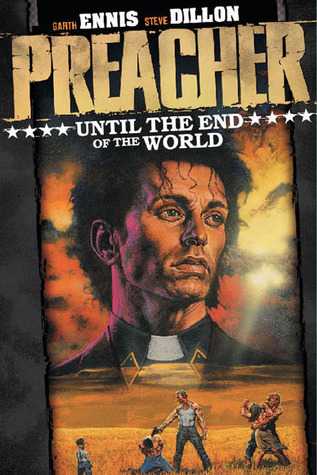
After taking the first 10 days off from the Reading Challenge in November, and following the first regular-sized novel, I was then forced to move to some shorter novels for fear of not being able to live up to the 3-book challenge this month. A couple of these shorter ones were by Stephen Kin / Richard Bachman, and since his new book “Elevation” clearly states that it is in fact a novel right there on the front cover, then I'm going to say this swift little number totally counts. “Elevation” is a read-it-in-one-sitting novel, to be sure, it actually turned out to be one of my favourites by Stephen King, following an outrageous premise with our trusted author guiding the rather poignant plot through his well-drawn-out characters. This I read after the so-so “The Longest Night”, an old direct-to-paperback novel by 80s horror scribe J.N. Williamson. The book started off well, with a violent shoot-out in an old bordello, but the the ghost story remained at a simmer despite the good characters. I was actually really looking forward to this one, too. So back to King (or Bachman, rather), for the last of the original Bachman books that I'd never read – “The Running Man”. I remember I'd tried to ready this book back in 1987 after finding a paperback copy featuring Arnold Schwarzenegger in a Save-On-Foods – and promptly lost interest when it was clear withing the first two chapters that this was going to be nothing like the Schwarzenegger actioneer... Actually, I'm glad I waited, I would not have appreciated the biting dystopian satire as much back then. (Try reading this thing now in post-9/11 Trump times. Yikes). Still needing my retro-horror fix (I guess), I came across a copy of Harry Adam Knight's “Worm”, about the attack of several gigantic worms – and I was hugely surprised by this one – not just fast-paced and gory, but really well written, to boot, and the horror circled around a neo-noir-ish hard boiled world. I found out later that Harry Adam Knight was actually a pseudonym for a celebrated Australian author, who'd had a handful of his genre novels turned into films during his lifetime (he died in 2005). After these four horror novels (well, maybe “Elevation” wasn't exactly horror), I had the inspired notion that I could get two more “Preacher” books in – alas, I got one down. But overall, not too shabby for missing the first third of the month. I'll be starting December with the next “Preacher” graphic novel, though. 

--V.


Tuesday, October 30, 2018

3 Books a Month – October (Scary Readings)

Okay, quick re-cap although we're five month into this now – lovely wife and partner Nicole D'Amato created a three-book-a-month challenge. For October, I may have leaned slightly towards Stephen King. And it may have been a little infectious. Not only was 1408 one of the Halloween horror movies watched (re-watched) this month, but Nicki was compelled to delve into King's “Pet Sematary” over a re-watch of Mary Lambert's incredible film version. Admittedly, I also had only read King's “Pet Sematary” novel earlier this year. However, I feel I made up for that infraction by consuming not only one of my favourite Bachman Book (and King's least favourite), “Roadwork”. I had no expectations for this novel and found it King at some of his most mundanely humane – and I actually mean this in a very good way. His take on marriage and human relationships are far ahead of his then-young years (the novel was written in the seventies, post-'Salem's Lot). 

Adding to this I actually, finally, read “The Skin Trade” (aka “Dark Visions”) which includes stories by Stephen King, Dan Simmons (as I continues the exploration of his work from last month's “Lovedeath”), and George RR “Game of Thrones” Martin, in his experimental horror days. The standout of this book, for me, was an otherwise-unpublished novella by Stephen King titles Dedication. Can't explain that one here, but should be read, and I was so glad that it was at least published as part of this literary genre anthology. 

I also worked in a retrospective of Ray Russell's gothic works, published by Penguin and curated by filmmaker Guillermo Del Toro, titled “Haunted Castles”. Ray Russell is fast become one of my favourite underrated genre writers. (If you can get it, please read his short novel “A Case against Satan”). 

And lastly, while I was fully intending to take in yet another Preacher graphic novel, that intention was thwarted whan I came across a novel by Craig Spector – one half of the 80s-90s splatterpunk team of Skipp/Spector – in a thrift shop for a buck. Truthfully, I'd been interested in this book, “To Bury the Dead”, for quite some time. I'd read one of John Skipp's solo efforts (post-”Animals”), but I was curious about Craig Spector's solo work as well. During the reading of “To Bury the Dead”, I have to admit, I was mostly left with the feeling that from Spector's point of view, his writing really benefited from his previous partnership of John Skipp. Skipp's writing is more pared-down, pulpy, fast and furious. While Craig Spector undoubtedly maintains a high energy to his writing, it's thickly steeped in machismo and patriarchal heroism; it's testosterone-fueled to the point of being a little eyebrow-raising in these times. As fast as I was burning through the pages of “To Bury the Dead”, I was constantly and uncomfortably aware of the author's then-ideas of male-dominated ego-heroism. However, through the last fifty or so pages, things took a turn towards the existentially philosophical, turning something that at first appeared bizarrely conservative and right-wing into a work that explored ideas of, overall, understanding – which sort of saved this novel for me (and took it in a turn towards the surprising liberal). If anything, Spector's novel ends up being an experience in the complexities of Americans' personal beliefs and politics, and ideals that may have been built in the blood of America but has also softened in the education of the people. I'm actually glad I read this novel for the first time in the currently heated times of America, Americans, and their politics. It gives a strange light to Spector's work. Conversely, of you might be interested in his ex-writing-partner's anarchic horror-lit, may I recommend Skipps's “The Long Last Call”. Next month, I'll be back on Preacher! 

--Vince 

Tuesday, October 02, 2018

3 Books a Month – September (The Last of the Summer Readings)


Alright, we're officially into fall and the Halloween season! Of course that didn't quite stop be from getting my horror on with September's book challenge (still ongoing between Nicole D'Amato and myself – and any friends that care to partake as sort of a self-challenge). Strangely, my first book book of the month was only the second novel I've ever read by the brilliant Peter Straub. Well, possibly the first novel, as the previous book I'd read had actually been his short story collection Houses Without Doors, and I'd read that way back in the 90s after having finished the Straub/King collaboration The Talisman. Anyway, I'd been in a used bookstore in Santa Monica when I accidentally came across a bent-up recent publication of Peter Straub's 70s thriller If You Could See Me Now. Reading this murder-mystery for the first time, with its dangerous smalltown redneck flavour and supernatural creep-factor, it struck me just how influential this novel might have been to the works of upcoming horror authors and filmmakers – and I say might have been, because in truth I'm not sure what the critical or commercial response to this book was when it was first published in the 70s, but I wouldn't be surprised to find out that it actually had a direct influence on other genre works. Moving from If You Could See Me Now to a weirdly similarly-toned The Wasp
Factory by Iain Banks, the prose in the latter novel was far more contemporary (and should I even use the word “clever”? – I suppose that would be subjective) yet both novels retained the same tense, engagingly creepy, and mysterious gothic atmosphere that continually signaled that there was so much more going on beneath the surface of these novels' main plots. Following these two novels, I finally read a book that I had purchased back in the 1990s (around the same time as I'd purchased Straub's Houses Without Doors, it would be extremely safe to assume), Dan Simmons' LoveDeath – LoveDeath is a collection of novellas dealing with the often horrifying and always tantalizing themes of love, sex, death, and violent bloodshed. Some of the works in this book are existentially haunting, other parts are terrorizing, and of course, there are some decent doses of humour, because really, what's sex and death without a little bit of nervous laughter? Everything in Simmons' book is extremely readable, although
Simmons' prose is such that it quite literally demands and simultaneously commands the reader's attention. Not concentration, just attention, and thereby the reading of LoveDeath felt more intense to me than the other horror literature I'd consumed this month – and of course, all of these books were so very appropriate in leading into the fall/Halloween season. Finishing my three books a couple of days before the monthly deadline, I once again went back to Preacher (as season three is still not available on Prime! Come on, Amazon!!) and I've now gone all linear – last month, I'd read the fourth book in the originally-compiled 9-book series (the series has since been re-compiled and re-published in a slightly different order and context over six books), and now I've firmly placed myself in the proper order, having devoured Preacher Vol. 1 – Gone to Texas, which collected the first seven comics in the long-running series. Hopefully, I'll have Vol. 2 in my hands by the end of October. 

--V.
 

Sunday, September 02, 2018

3 Books a Month – August (Summer Reading)


At first, I thought I wasn't going to meet the challenge this month! (For those new to this, my wife Nicki and have currently have a three-books-a-month challenge taking place – indefinitely. It started in June). However, I actually passed the goal quite literally (ha!) in the eleventh hour on the 31st – of course, if you were to ask Nicki about it, she;d tell you that my last book didn't count. More on that later. So, the reason I almost didn't make the goal this August was actually in part the fault of the first book I'd read – Joe R. Lansdale's “The Thicket”. I've always loved Lansdale's work, though he's one of my favourite authors whose books I seem to only get around to every couple of years (I've really gotta change that, there are still a few of his early ones I haven't gotten to yet) – but hands-down, “The Thicket” is now my favourite Lansdale book. It's a Western-type of seek-and-revenge tale, with a Southern existential weirdness that really only Lansdale can do justice to (especially as he practically invented this style). This one is definitely the pick of the month. Following this, I absolutely devoured Stephen King's latest, “The Outsider”. And as much as I loved this book and the insane plot turns it took following the arrest of a child-killer who may or may not be innocent, and who was widely adored in his own community, I have to admit I was slightly annoyed (only slightly, mind you) as I was getting to the finale of the novel only to realize that there was a reliance on characters introduced earlier in King's “Mr. Mercedes” trilogy, which I had/have not read yet. Minor thing, though, but I'm a little OCD (just ask Nicki) and so I would've liked to have known that beforehand, and I might've read Mr. Mercedes first. At any rate, “The Outsider” is still very much recommend.
Finishing this novel was where the trouble began – I was dying to go back to something Lansdale-esque. But instead of reading another book, I launched into the Preacher television series on Amazon Prime and binge-watched the first two seasons. (I would've done three, but the third season wasn't available yet. Which might've been a good thing). As I ran out of Preacher episodes to gorge myself on, I remembered that back when I was experimenting with getting into graphic novels, I had actually purchased a Preacher book – Volume 4, “Ancient History”. I honestly couldn't tell you how long I'd held onto that graphic novel for, having purchased it years ago from Golden Age Comics on Granville Street. I can tell you that it had been stuffed to the back of the top shelf of the bedroom closet, and at one in the morning it wasn't going to go over really well if I woke Nicki up digging through my back-issues of The Walking Dead and Marvel Zombies to find this fucking thing, so I gave up after a cursory glance. Instead, I went for a trade paperback that my friend Vincent Ternida had given us a few days earlier – it was, in fact, his
first published novel. “The Seven Muses of Harry Salcedo” regards the trials and tribulations of singles-dating in Vancouver, told from Vincent's keen eye on Vancouver living and getting through a daily grind in what is often a schizophrenic city, even for people who were born here. His observations on the city are humorously perfect (the description of his “Java Mausoleum” in the first chapter instantly reminded me of the time I saw two young women carrying a new espresso machine to the cashier in the downtown Best Buy while both of them were carrying Venti Starbucks coffee beverages); and the description of Harry's dating life are colorfully painted with his uncannily acute sardonic/loving descriptions of culture in the city. As I actually managed to finish my friend's first novel before the
end of August, I found myself with one day to spare, so I did dig out the Preacher graphic novel (in the daytime, as to not find myself in the same predicament as two nights earlier), and finished it off on the 31
st. Although Nicki will maintain that “comics don't count” (okay, I might be paraphrasing there), I disagree when said comic is over 200 pages and boasts a lot of text and the stylized writing of Garth Ennis. “Ancient History” was mostly filmed in the first two seasons of Preacher, but I have to say that it temporarily satisfied my newfound addiction and gave me a new-found appreciation for the original graphic novels. Now all I have to do is track down the other eight books from the original saga... 

--V. 

Sunday, August 05, 2018

3 Books a Month – July (Summer Reading)


Happily continuing the three-books-a-month challenge, and getting halfway through some fantastic summer reading, I actually tried to be a little more ambitious than the three book-minimum and hit the four-book mark (proud as I was to have been able to do this last month) – alas, this was not meant to be – apparently, I was a hell of a lot busier in July than I was in June. Thinking back on this, I'm going to say this was true – at one point I found myself in over my head with a graphic design project while on a plane heading to a horror film festival – the very plane I was supposed to have been reading that elusive fourth book of the month. I decided at that point it would be alright to save the book for the flight back, the same flight in which the novel (Ian Banks' “The Wasp Factory”, if you're interested) wound up in the elastic-strapped back pouch of the seat in front of me while I watched Daddy's Home 2 all the way back to Vancouver; and despite even having a couple of hours to kill at LAX, most of that time was eaten up chatting with a couple from Philadelphia who had a ten-hour layover coming back back from a cruise. It was a nice chat, though. So, the three books I had managed to finish before that last week in July were my requisite three for the three-book challenge. The first book, “Cosmopolis” by Don DeLillo, was a fanatical and sexualized ride through the poetry of finances, global economic breakdown, and revenge. It was also a novel I had thoroughly wished that I had read a few years ago, before filming Odissea della Morte. The next one, a recommendation from last month's challenge, was Shirley Jackson's “We Have Always Lived in this Castle”, which turned out to be laced with unyielding philosophical insights into the good and the bad of human nature, and what, sardonically, might really be the actions behind what makes us “good”. This novel ended up being one of the best pieces of literature that I've read in a very long time. I had to return that one to the local library, but I'll be on the lookout for it now to purchase. The last of these three books was a Roberto Bolano book I'd found totally by fluke at the same library (and at the same time) I was returning the Shirley Jackson novel to – my eye caught it on the way out, and I picked it up before leaving the library; it was a Bolano book I'd never heard of before, “Una novelita Lumpen” – but reading it reminded me of how much I loved Bolano's “The Skating Rink” and “The Woes of the True Policeman”. “Una Novelita Lumpen” is a very quick read, and almost as good as “The Skating Rink”. It's bright and engaging and mysterious as it delves into the slightly enigmatic psyche of a young woman who, as a novice to sex and crime, ends up wildly involved in both. 


Monday, July 09, 2018

3 Books a Month...

So, my lovely wife and business partner (Darkside Releasing, Cinemafantastique) Nicole (or Nicki, as she's called at home) proposed a literary challenge to me: reading three books per month, within the calendar months (so books started before the 1st don't count, nor do books finished after the 30th/31st). Tough! But doable, right? Stephen King claims to be a "slow reader" and yet he gets through around 80 books every year. 3 books per month is only 36 books a year. Easy peasy, Right? We tried to rope some of our other literate friends into joining this challenge with us, but even the booklovers that these friends our, our challenge was bet with immediate self-doubt. But then again, that is sort of the point of a challenge -- if it was easy, it wouldn't exactly be a challenge, then, would it?

I did make it through the first month, with 4 books, no less, and am on my way towards the July finish line. Here's what I got through (and thoroughly enjoyed, I should add, for all four of these titles), for the month of JUNE...


Thursday, June 07, 2018

The Mysteries of Donald Westlake's “Memory”


Donald E. Westlake might be best known as the author and creator of the hard-boiled Parker character that features in several literary and cinemaitc fictional outings. But a few years ago, a smaller publisher called Hard Case Crime published one of the author's missing, or . “never before published” works, entitled “Memory”.

Written in the 1950s, the plot concerns an up-and-coming stage actor who suddenly loses his functions for all faculties and facilitation of proper memory because of an attack by an angry husband, whose wife the actor had been having an affair with. The betrayed husband hits the actor over the head with a wooden chair, and the novel opens up in the hospital as the actor is awakening from this attack, only to find that he has lost every facet of his previously-working memory. He's lost his short-term memory, his long-term memory, and his ability to retain any memory past the near-present, unless he develops a fairly strict pattern of absolute repetition in his existence. This pattern has to be constantly supported with self-written notes and reminders through the underneath of the new daily routine. Donald Westlake then takes us on a four-hundred-plus-page journey through his lead character's existential nightmare; which for me, raised some skin-prickling philosophical questions, as well as a very big brain-nagging culture question...

The cultural question might not be what one might consider to be expected – in that my own question is actually relegated to something else that has popped up regarding Westlake's themes of memory loss, and to a great contribution to pop culture at that – through Christopher Nolan's breakout film, Memento. My question on this, where in Nolan's film his lead character suffers with the very same existential nightmare as that of Westlake's creation, is sort of a two-parter: Did Nolan somehow have the opportunity the claimed “never before published” manuscript, and was then able in incorporate many of these philosophical ideas of memory and existence into his own screenplay for Memento – or – are these questions just existentially inherent in any of us (like Christopher Nolan and/or Donald Westlake) for us to delve into if the notion ever occurs to us to ask?

My second question as to the mystery of Westlake's book, then, concerns the philosophy itself: Does existence actually really matter if we have no memory to use to incorporate, and in a sense, categorize (and even internalize), our own existence? With huge credit given toward Donald Westlake, he actually attempts to (and depending on your personal opinions, he does) answer these nearly mind-boggling questions. These are questions that stretch our imaginations, to be sure, as well as our own anxieties and nightmares about what it is to be a human being. The nearly heart-wrenching (yet surprisingly subtle and deeply meaningful) ending to Westlake's novel Memory might give most people answers to these philosophical questions, whether they wanted them or not – because the conclusion depends on if living in the present is exciting or horrifying, in your personal perspectives, which is what makes the entire novel, from page one, utterly riveting.

(The film, Memento...)


Sunday, June 03, 2018

MAXIMUM OVERDRIVE

In light of the next “Absolute Horror” column being published in the upcoming summer issue of Absolute Underground, where I chat for a while about one of my favourite authors Stephen King, I thought it might been fun to revisit this piece I wrote about his film, Maximum Overdrive, nearly seven years ago, which I'd always had fond memories of writing up for the UK website Videotape Swap Shop – which itself is now long since defunct.

The article was not as awesome nor as insightful as I'd remembered it to be. It's still a little fun, though. And I still hold a lot of gratitude for that now-gone website, VTSS, which was always quite supportive of my articles. (Huge thanks to Michael & Hannah)


MAXIMUM OVERDRIVE
by Vince D'Amato
(Originally published December 18, 2011)


Car movies, and especially their more-specific crossover cousin the car/road flicks, are something of specifically American cinema culture, having epitomized its heyday throughout the seventies. Coincidentally, this was also the decade Stephen King had his first novel published. And here's a man who has gleefully mixed America's obsession with the automobile as class status and bullet-fast horror and suspense throughout his career – with the likes of
Christine, From a Buick 8, Riding the Bullet, and Dolan's Cadillac just to name a few. When he made his movie deal in the mid-eighties with movie mogul-producer Dino De Laurentiis, It's really no wonder that King figured highways, trucks, and bloody horror would make for a killer directorial debut, and hand-picked his own short story, “Trucks”, as the key concept for his first (and subsequently only) self-directed adaptation of his own literary works.

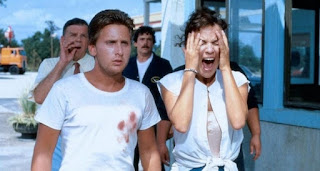
The concept of King's original short story, which appears in the short story collection “Night Shift”, concerns a bunch of trucks that suddenly possess homicidal tendencies. In the film version, this happens after the earth is caught in the tail of a passing comet, trapping a bunch of truckers, diner staff, and a bible salesman inside the Dixie Boy Truck Stop Diner, with King here doing his best (or taking the piss?) while he tries to explain why the trucks went mental in the first place, something left out of the original short story, and something that is usually left out of his best works. King works incredibly confidently on the what is happening level, but in Maximum Overdrive, the why it's happening is almost gleefully far-fetched, even for a movie where machines suddenly get brains and start killing any humans they can't trap into becoming slaves. Speaking of which, how is it that the newlywed couple were able to keep control of their vehicle through all this...? Anyway...

With a pretty impressive cast including the reliable Pat Hingle (who easily steals the show), Emilio Estevez, Leon Rippy, Giancarlo Esposito (in one of his earliest minor roles), Lisa Simpson, and King's own discovery, Laura Harrington
(What's Eating Gilbert Grape), it's a shame King wasn't able to direct them with the same Americana satire that shines from the characters of his novels. Instead, everyone acts how HE acts in his films (see: CREEPSHOW); mainly, by over-acting to the point where the characters go beyond satire into Looney Tunes. Weirdly, though, this actually all sits pretty well with his over-the-top idea of seeing all the machines in the world suddenly going on a homicidal rampage, and compliments the outrageous style of the movie itself – and there are some truly funny moments, too. Meanwhile, all signs of subtlety are thrown out the window with within the first four seconds of the film, which nicely sets up what we're all in for as an audience.

And as if this weren't all legendary enough, King, ever the rock 'n' roll fan, hired none other than AC/DC to provide the screeching and hyper-catchy soundtrack. But what I want to know is how producer Dino De Laurentiis got King the rights to use the Green Goblin's head on the killer eighteen-wheeler toy delivery truck that's forever known as the cult mascot of this ridiculous but compulsively watchable cartoonish thrill ride. Okay, it's no
Shining or Shawshank or Mist or Pet Sematary, but King's cinematic creation has an ingrained warped sense of humor, and the satire does come shining through when the paper-thin walls of the mundaneness and routine of The American Way (circa 1986) come crashing down. Reading too much into this? Nah. It's awesome in its own unique way, it's a film I've watched a dozen times. It's like comfort food. Not really good for you, but damn it, there's just something so satisfying about it anyway. Then again, maybe it's just the exploding toilet paper truck, as if King is yelling at us from behind the camera: Heads up, you're in for a steaming pile of shit, and we're loving it!