Groovy & Wild Films from Around the World

Showing posts with label Vertigo/DePalma (series). Show all posts

Sunday, August 26, 2018

Vertigo/De Palma - Part VI

* * * Part VI (The Scream/End Credits)***

Femme Fatale was the first real-feeling DePalma film I'd seen in the cinema. I had actually seen Carlito's Way and Snake Eyes in the cinema as well, but Femme Fatale was the first DePalma theatrical experience where I felt I was watching a film that could've been made during the time of his master trilogy of the early 80s. Femme Fatale was the extension of Dressed to Kill, Blow Out, and Body Double that it seemed Raising Cain had hoped to be in the 90s. Perhaps Raising Cain would have been more secured in that creative extension had DePalma been able to figure our how to edit the film in the manner that he'd originally envisioned. But with Femme Fatale, it was apparent that he had fully creative reign when it came to his experimental non-linear storytelling. Femme Fatale would be another revisiting of Vertigo themes while Raising Cain had served as a remake of DePalma's own Dressed to Kill, which of course, was a remake of Hitchcock's Psycho. Perhaps Raising Cain, then, would serve as a first offering of a post-1980s trilogy in and of itself, featuring Raising Cain, Femme Fatale, and finally Passion, which would also deal with the nightmarishly-presented ideas of Rachel McAdams having her own “double” that was haunting the thoughts and actions of Noomi Rapace. Indeed, the list of these six films undoubtedly make up the “key” and an importantly defining portion of DePalma's catalogue – Dressed to Kill, Blow Out, Body Double, Raising Cain, Femme Fatale, and Passion, which ironically (even if this was unintended) loops the modern idea of how society receives its modern media with the studio-television monitors, 16mm projected film, and newspapers of 1973's Sisters.
* * *

With all of its similarities, it was the final shot of Vertigo that really grabbed my attention and shook me out of my seat. It was the scream.

But twenty-four years before this, it was a television trailer for Carlito's Way (1993) that had grabbed my attention in a completely different fashion; it would be the first Brian DePalma movie I'd have the opportunity to see in the cinema ever and since discovering his films on VHS thanks to a handful of video rental stores in North Vancouver. My brother and I went to see Carlito's Way after it opened at what at the time was North Vancouver's only multi-screen cinema in an outdoor retail complex called Park & Tilford. Before the movie theatre opened there, Park & Tilford was a destination for families during the Christmas season because of the elaborate Christmas display of lights and decorations that were weaved through a monumental garden tunnel-path. And really, this was the only thing housed at the Park & Tilford location for years until the movie theatre went up, followed by a huge Canadian grocery store (Save-On-Foods) and soon afterwards, Blockbuster Video. I even rented Carlito's Way for a second and third viewing from this Blockbuster Video on latter occasions. Carlito's Way was really the epitome of flashback-sequence storytelling as the entire film was essentially one long flashback sequence.

The movie opens up with a shot of Al Pacino (“Carlito” in the film) being carried away, dying, on a paramedics' stretcher out of the tunnels of New York's Grand Central Station. The location immediately recalls the backdrop of important Blow Out scenes, including scenes leading up to the climax of that film. Even the reason that the two sets of leading characters from each of those two films are the same: they're catching a train out of town to hopefully outrun the bad guys. In the opening shots of Carlito's Way, we have DePalma telling us that it's the climax of Carlito's Way that is going to play out in the same locations. We also have him telling us, directly, the ultimate fate of his own leading character, and then invites us to find out if he was lying to us or not; taking us through two and a half hours of Carlito's flashback story. After the opening credits play out, with Carlito lifted from the train platform and transported away on an ambulance gurney, we see him a few months previous to this in a courtroom as his prison sentence has just been revoked due to illegal wire-tapping by the District Attorney, and so right away, we get another Blow Out reference, or at the very least another gentle reminder of that film. Again, hidden wires, microphones, and audio recordings play a minor but significant role in this film as well. The circling camera shot around Pacino and his love interest Penelope Ann Miller midway through the film reminds us of the same shot midway through Body Double (nineteen years earlier). Much of DePalma's filmography holds up years and decades after-the-fact, Carlito's Way in particular seems to get better with age, crawling up on Martin Scorsese's GoodFellas as best gangster movie. In fact, I believe one of the best scenes DePalma has ever film is the fight between Pacino and Miller, which takes place in her apartment – the two characters, arguing their own moral logic, remain separated by space, walls, and doorways until the argument reaches its heated moments – Pacino pushing his way into her bathroom, where Miller is standing, yet the two of them continue to argue without looking at each other, their heads are backside-to-backside. Finally breaking this disconnection that is coming between them, instead of looking directly at each other, they face each other in the bathroom mirror, where they are forced to face each other and themselves as slightly warped, opposite-reflections of themselves, until he finally breaks the mirror with his fist – cutting his hand. She follows him out of the apartment, like she would follow him later in her life, and she lets him go without her, as he would let her go without him at the end of the film, from the platform of Grand Central Station. Miller yells after him as Pacino disappears from her apartment: “I'm through cleaning up your blood!” – And she is through, she won't have to clean up his blood again, next time, the paramedics are going to do it for her. Unlike Nancy Allen's prostitute-with-brains-and-a-heart-of-gold character form Blow Out, Miller will get away from all the blood and crime that she'd been trapped in inside the city. Carlito's Way ends with her dancing in paradise.

Blow Out ends on a far more cynical note, made palatable only by the multi-layered irony that DePalma has brilliantly twisted it all into at the end of the story. Hitchcock himself had set-up a beautifully ironic twist at the end of his masterpiece Vertigo. At Vertigo's halfway point, as James Stewart has had to give up his ascent to the top of the bell tower, the last thing he hears is Novak's scream before the body falls, seemingly to its death, from the top of that tower. As the clues build up to a tense and wholly uncomfortable climax at the end of Vertigo, Stewart realizes that he had heard Novak's scream before seeing the body fall – only it wasn't her body. It was all a set-up to place Stewart as the only “witness” to another woman's “suicide” – all this an elaborate cover-up for the other woman's murder. As Stewart literally drags Novak back to the scene of the crime, he overcomes his crippling vertigo and manages to get them both up to the top of the bell tower, where the murder victim had been thrown. As they teeter on the edge of the tower, Novak, riddled with angst and anxiety, gets spooked by something in the shadows and accidentally falls to her death from the tower, her scream echoing once again for Stewart, but this time the scream isn't staged.

When DePalma's Blow Out opens up, we see John Travolta in a private screening room with the slasher b-movie producer, mixing the sound effects track for their horror movie. They are in need of a “good scream”. DePalma uses this detail of Travolta's background for some humourous scenes throughout the movie – as Travolta runs about the city trying to solve the apparent murder he's captured on his tape recorder, he's suddenly brought back into his everyday-world reality of having to test voice-over actresses in order to record the perfect scream for his producer. Still, they can't find the right one. The fact that the creepy villain-hitman of Blow Out (Lithgow) has ransacked Travolta's sound studio and erased every single recorded and meticulously catalogued sound-effect tape Travolta has ever created just puts him further back from ever being able to finish the work that his dayjob (and only source of money) requires. Throughout the entire film the circumstances surrounding Travolta's character only serve to push him further and further into a corner, until the climax of the film, where Travolta and Allen devise a plan to entrap the killer by wiring Allen with a hidden microphone – a plan that backfires fatally for Allen, and Travolta is left stranded and helpless, unable to help Allen as she screams harshly to her death through the headphones in Travolta's ears.
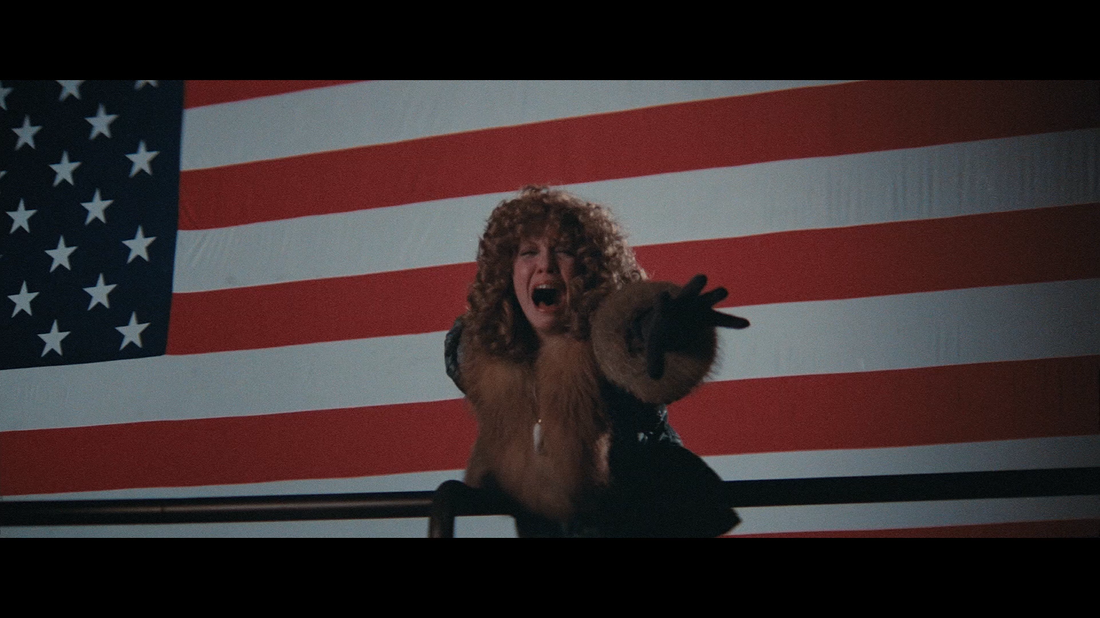
DePalma leaves us watching Travolta, in his own personal hell inside the private screening room with his b-movie producer, having to listen to Allen's death-screams over and over and over again; the only scream that he, the sound recordist, would have on tape in order that he could finally finish his job on the low-budget slasher film in front of him. That final scream would be the only thing John Travolta would walk away with by the end of that film, just like Novak's scream would be the only thing Stewart would walk away with, in spite of all his obsessions, at the end of his.

THE END
VERTIGO/DE PALMA by Vince D'Amato.
Copyright (c) 2017 by Vince D'Amato, All Rights Reserved. First published as an E-book, non-fiction, 2018. All photos are stock/promotional photos from their respective studios: Universal Studios (Vertigo), Warner Bros. (Femme Fatale), Warner Bros., MGM (Blow Out).

Sunday, July 15, 2018

Vertigo/DePalma - Part V

* * * Part V

As a cinephile, I have made it my business to collect as many films that I find intriguing, interesting, exciting, and engaging as I could find – the harder to find, the better the challenge. Such was the case with many of Dario Argento's films during my collecting in the 1990s, his films were continually hard (or nearly impossible) to come by until the advent of DVD around the turn of the millennium. Strangely, though, I was never compelled to collect DePalma's movies on VHS, in spite of my adoration for his work. Mostly, I would just rent and re-rent the VHS copies of Carrie, Blow Out, Body Double, Dressed to Kill, Carlito's Way, with only a couple of exceptions, which pertained only to his earlier films – Obsession was one of the VHS videotapes I was lucky to have come by on a shopping excursion to Bellingham, Washington; I'd found a copy of this movie in a VHS retail chain called Suncoast Motion Pictures. Obsession was one of DePalma's titles that I'd never been able to find up until that point, and so after making the purchase it would be the fist time I'd experience that thriller, which starred Genvieve Bujold, Cliff Robertson, and John Lithgow – with Bujold playing a dual-role as doubles. Obsession is DePalma's actually first stab at remaking Vertigo, with the first Bujold character having met her death in a firey car chasing following a botched kidnapping-for-ransom. Cliff Robertson's character then meets Bujold's younger double, fifteen years later, in an unlikely scenario in Florence, Italy. But this is once place DePalma shines as a storyteller – not only in making us believe in these unlikely coincidences, but in his ability to make us want to believe in them. There is actually something genuinely and inherently (and strangely, even innocently) romantic about DePalma's storytelling.

The other VHS tape I'd purchased was Sisters, thanks to that videostore owner who let me buy it right off of the rental shelf of his store. The third and last VHS tape I ever acquired of DePalma's catalogue was The Fury, and this videotape had been given to my by one of my sisters as a Christmas present one year in the late 90s.

* * *

The Fury (1978) marks a very intriguing spot in DePalma's overall catalogue, due to its cinematic content and its context within his filmography – it's a horror-thriller based on a popular horror novel of that time, and incorporates many of the virtuoso camera flourishes that would become the stylistic hallmark of his following films of the 80s. The Fury is essentially the bridge between DePalma's early horror adaptations (Carrie, from the Stephen King novel, and Phantom of the Paradise, a wild twist on “Phantom of the Opera”) and his trip of erotic-thriller masterpieces of the early 80s. The Fury expertly weaves and experiments further on the stylish cinematography and non-linear storytelling of his early thrillers Sisters and Obsession with the visceral energy and immediacy (paradoxically executed through long fluid shots and slow-motion camerawork) of his horror films, Carrie and The Phantom of the Paradox (the latter being more of a horror-thriller-musical in the style of, but superior to in this writer's opinion, The Rocky Horror Picture Show). This would all culminate in DePalma's unofficial Psycho remake, Dressed to Kill in 1980, the film that would really put DePalma on the map.

Although DePalma had toyed with placing media and media technology in his stories before the 1980s, with the television monitors and newspaper writers is Sisters and the series of slide-photographs that help to open the film Obsession, it wouldn't be until after Dressed to Kill that he would really start experimenting with ideas of incorporating all sorts of media and technology in his films. Of course, Blow Out featuring jon Travolta s our sound technician and hero was really the striking point for this, his subsequent Vertigo remake – Body Double – intriguingly toyed with the then-new videotape media that was just making its presence known in mainstream society, both in the consumer realm as well as the production realm. Following Wasson's first investigative moves through the Hollywood video rental store, he then manages to get himself hired onto an actual porn production in order to be able to meet with Melanie Griffith, the body double of the film's murder victim. DePalma takes us through the entire porn-scene production in one amazingly fluid set-piece that was: A) Aped by Quentin Tarantino for his celebrated Inglourious Basterds sequence that opens the fifth chapter of that film; and: B) Set to a pulse-pounding rock soundtrack that would serve as DePalma's foray into “rock video” territory, something that was in fashion within the Hollywood studios of that time. DePalma knew that he was basically shooting a rock video in service of this behind-the-scenes porn-movie sequence, making the entire scene a double-meta affair: A porn movie shot from behind-the-scenes as a rock video inside a movie that is about Hollywood b-movie and porn-movie actors, based on another movie from twenty-five years previous. Sound complex? It's not, because another one of Brian DePalma's brilliant talents is the ability to keep all of these overlapping meta-themes subtly riding the undercurrent of his actual story, about sex, voyeurism, and murder, without allowing these subtextual themes and secret criticisms of voyeuristic media to get in the way of his expertly stylized proceedings. Using a single word, DePalma basically has a firm grasp on his own cinematic style.

After DePalma would continue his stylistic approach to incorporating media tech into his films, with Raising Cain, Mission Impossible, Snake Eyes, and Femme Fatale, he would eventually twist the whole aspect of all of these films' opening sequences in his latest film Passion (2012), which would open up on a shot of the two lead heroines, both of whom are focused in on the screen of a MacBook laptop. For once, DePalma's camera is not showing us the images on the screen, instead, we're make to patiently sit while watching the two women (Rachel McAdams and Noomi Rapace) as they watch their shared computer screen (also sitting). We see only their faces and bodies and the back of the computer – they're the ones watching, and we don't know what they're watching, and it is never revealed, marking a first for a DePalma film. Soon, however, DePalma allows us to discover that McAdams and Rapace work for a mega-conglomerate media corporation in Europe. And sooner than later, iPhones, YouTube, security cameras, laptop cameras, and commercial media all quickly slither their way, extremely prominently, into DePalma's new take on the story of sexual and corporate power-plays, murder, and double-crosses and backstabbing while still managing to interweave the very importance of dream and nightmare sequences into his personal storytelling. If Passion is to be DePalma's last film, then he certainly went out at his peak, which is astounding unto itself considering his first notable step into the heavy-hitting cinema-auteur arena was Sisters, almost forty years before Passion was released. Sadly, Passion only received a limited theatrical release in North America, another signal of the changing media technology and the way popular media is delivered (and demanded) in society in 2012. The very way that iPhones/uploading/video-streaming marked the shift in Rapace's character's corporate power-position in Passion would wind up being the very reason that DePalma's brilliant thriller would receive very little attention in the cinemas and on hard-copy media distribution. It may have fared better with a VOD streaming release; but of course, watching a DePalma film on a Smart Phone is no way to watch a DePalma film at all...

(To be continued...)

Sunday, May 27, 2018

Vertigo/DePalma - IV

Part IV

...Another notable cinematographic trait from Vertigo [that DePalma utilized in his own films] was Novak's flashback whilst sitting alone in her bedroom. Here, the camera has framed the actress perfectly as she proceeds to write a note detailing her involvement in what we thought was her double's suicide up until now – where she admits, via her own voice-over and visualized for us (the audience) through a lengthy flashback of the bell tower scene, revealing visual information that we had not been privy to when the scene had originally played out earlier, that the “suicide” had been in fact a cover for murderous goings-ons. The mis-en-scene in the hotel room during the flashback brings to mind the excitingly framed flashback sequence from DePalma's The Fury when Amy Irving pauses halfway up an interior stairway and receives a psychic vision of her missing brother. DePalma shows us this vision as a split-screen as Irving remains frozen on the steps for us to witness her reacting to the vision – and while DePalma had played with dual-screen storytelling before in Sisters and The Phantom of the Paradise, he had never displayed it in this tricky and clever manner before – instead of the standard dividing line between the two scenes playing simultaneously, in The Fury, literally half of the backdrop surrounding Irving dissolves away into the vision she's having as the camera turns around her. Here, DePalma has displayed his most brilliant take on the dual-screen technique. The whole flashback trope also teeters over experimental territory, and although DePalma was no stranger to this form on non-linear storytelling, he wouldn't fully experiment with it until his later films, Raising Cain, wherein his seemingly overlapping flashbacks and dream sequences were viewed as too experimental for its time (1991) and DePalma succumbed to the pressure to re-cut his film into its current “theatrical release” version. Since that time, Raising Cain has been recut into a pseudo- “director's” cut where the scenes of real time, flashback, and dream fantasy have been restructured back into a form more closely resembling DePalma's original idea for Raising Cain. (This latter version is now available on a newer home video release). The epitome of DePalma's use of flashbacks had to have been his sophisticated, intricate, and suspenseful reveal of how and why Ethan Hunt's (Tom Cruise's) team of spies had been set-up and killed in the big-budget blockbuster Mission Impossible. This flashback sequence of DePalma's is particularly fantastic because as the sequence plays out as Tom Cruise's inner thoughts, mixing memory with gap-filling logic and circumstantial accusations, John Voight is sitting across from him simultaneously relaying a series of lies and his own false accusations, speaking while the flashback is occurring. The killing of the Mission Impossible team also happened in the first half hour of this exciting action film, literally and cinematically amping up the heroes-dying-halfway-through idea that had so intrigued Hitchcock in Vertigo and Psycho.

The ultimate experiment in non-linear storytelling for DePalma would happen a few years after Raising Cain and Mission Impossible. It would be the next decade, in fact, in 2002, when DePalma utilized a hugely extravagant flash-forward for the entire second act and continuing halfway through the third act of Femme Fatale, without even letting the audience in on it until the last few minutes of the film. At this point in his career, DePalma knew exactly how experimental he was being, he held no allusions that the climax of Femme Fatale might alienate his theatrical audiences. He was looking forward to the reaction that his film would get when it was released into cinemas.

DePalma's inspired fascination with both cinema and media serves to set up nearly every one of his key films in their opening frames. Sisters opens up with a shot on a broadcast television monitor. This was in 1973, and when DePalma returned to this idea of opening his films with televised monitors two decades later, he'd be nearly relentless with this idea. Raising Cain opens with a shot of a video baby monitor in a parents' bedroom. Mission Impossible with a shot of a live-camera monitor, monitored by a group of spies. DePalma had an obvious field day playing with interweaving video technology where a group of spies is pitted against two other groups of spies in the midst of double-crosses and doubleback twists – this is the very epitome of voyeurism quite literally blown out of proportion. In Snake Eyes, DePalma opens the camera shot on a series of new footage monitors until the camera reveals the live footage in actuality, without cutting. From this, the camera continues to weave expertly without any noticeable visual cuts for nearly the next twenty minutes, emulating Hitchcock's Rope once again as the camera follows a rowdy and rambunctious police detective played by Nicholas Cage and setting up the entire first act of the film, introducing all of the film's key ensemble players. Snake Eyes is DePalma's version of Rope on high-octane steroids. Instead of containing the fluid action to the interior of an apartment, DePalma's single-setting is an entire Las Vegas casino and hotel, his cameras gliding across casino monitors, down hallways, around a boxing ring auditorium and across the ceiling overlooking the insides of a row of hotel suites, all elaborately decorated in individual colour schemes. It's no wonder DePalma needed to hire Nicholas Cage for the role, at that time he might've been the only Hollywood actor up to the challenge of out-scene-ing the scenery. As for DePalma's key thriller trilogy of the 1980s, none of them started out with television monitors, instead, Dressed to Kill begins with an outright dream-fantasy seemingly disconnected to the rest of the film's reality, while Blow Out and Body Double both begin with the making of a b-moive, and both of those movies retain the making of the b-movies as their underlying sub-plots (both to be twisted in irony by the ends of those films). It is finally Femme Fatale (2002) that culminated and somewhat epitomizes DePalma's cinematic and media fetishes together – the opening shot, post-90s-DePalma, is of a television (going all the way back to Sisters), but this time the television is not displaying anything that is happening within the reality of the film, as the opening shots of monitors had done in every single past instance DePalma had utilized this technique – this time, the television is playing, appropriately, a scene form the classic Hollywood film noir Double Indemnity. Watching this film on television, we see as the camera fulls back, is a nude Rebecca Romijn, lying across a hotel bed. This is preamble to a diamond heist that is about to occur during a celebratory night at the Cannes Film Festival. This move fixes DePalma's own cinema with his passion for media and cinema, and these themes continue on through Femme Fatale as our other leading character, Antonio Banders, is introduced as a media photographer. Television, cinema, photography, and mass-marketing advertising all crossover each other with DePalma's trademarks: sex and crime. And like Vertigo, Rebecca Romijn takes over for an uncanny doppelganger (also played by Romijn) when the weaker double commits suicide. Not as much of a remake of Vertigo as Body Double is, DePalma's Femme Fatale regardless freely uses and twists around Hitchcock's plotpoints regarding the heroine and her double. The diamond-heisting Romijn, the stronger, more sexually outward and confident one, even gets involved with the dead double's love interest, just as Novak had done with Stewart in Vertigo. DePalma's Femme Fatale actually plays out like Vertigo from the heroine's point of veiw as opposed to the male point of view, up until the third act where DePalma's experimental intentions are finally revealed, pulling the rug out from under the audience.

(To be continued...)


Sunday, May 13, 2018

Vertigo/DePalma - III

Part III

Media itself has played very integral roles in DePalma's most successful thrillers. Without exception in every one of DePlama's key films media has been organically integrated into the themes and plots of these thrillers. Of course, DePalma's use of media in these movies are a technological and societal development of voyeurism, something that Hitchcock also utilized to highly effective extents in Vertigo, Psycho, and of course, Rear Window. With Hitchcock's films, it was telescopes, windows and peepholes. DePalma turns a technological twist to all of this, as with the opening to his film Sisters, where he simultaneously engages his fiction characters and the audience themselves in an act of voyeurism through a filmed television screen which is broadcasting a clip of a new reality-game show that has its own basis in voyeurism – Margot Kidder is pretending to be a blind woman who has accidentally walked into the men's changing room at a gym, and proceeds to undress in front of one of the male clients. The idea of the fictitious game show is “What would he do?”, to which the studio audience and contestants (inside the film) have to take a guess in order to win the game show prize. And while this is all happening, DePalma is also slyly critiquing the whole idea of television media as just another, albeit accepted and even celebrated, form of voyeurism. An extension of Hitchcock's peephole-voyeurism that all of television-watching society condemns – and so DePalma is pointing out our, his film's audience's (and accepted society's), own hypocrisy when it comes to where the line is drawn with our sometimes vampiric voyeuristic tendencies. Media as a plot device then comes around again, this time in the forms of cameras and photography, in Dressed to Kill, where the young hero played by Keith Gordon sets up a hidden automatic time-lapse camera outside of his mother's psychiatrist's office so that he might capture evidence incriminating the psychiatrist in his mother's (Angie Dickinson's) murder. Camera and photography come around again in Femme Fatale, where a crucial photograph taken of a woman-in-hiding throws her fairy-tale world into turmoil when the photograph becomes a printed-media advertising sensation and is plastered all over Europe. In Blow Out, photography is present in the deepening complexity of the plot, but this film is more about the media utilized in the making of b-movies, specifically, recorded sound. In Blow Out it is John Travolta's sound recording that is, in effect, the first witness to a conspiratorial murder, but when Travolta teams up with the good-hearted prostitute Nancy Allen to utilize sound recordings and hidden microphones to solve the murder and capture the villain (John Lithgow), things go spinning out of control and Trovolta winds up completely lost and adrift in his personal world of sound, which throughout the film has become his own personal circle of hell. A precursor to Body Double, DePalma's Blow Out also perversely toys around with the heroine's “doubles”, as villain John Lithgow, needing to be rid of Allen's character as she was also a witness to the key murder in this story, decides to create an alibi for her impending murder by first murdering several other prostitutes who bear an uncanny likeness to Nancy Allen's character. This way, Allen's character's murder would look like a random one in a line of serial killings that had been plaguing the city. Here, then, we also begin to get a mix of slasher-film aesthetics in a film where Travolta is first seen sound-editing a b-movie slasher film; and also DePalma's increasingly flirtatious tango with the misogynistic controversy, something that celebrated writer Harlan Ellison had some very opinionated things to say about within the introduction of a paperback re-print of his book “Shatterday” in 1981.

Voyeurism went from the telescope and directly to the then-cutting-edge media technology of the videotape industry in Body Double. While windows still remained a key element through witch our characters' voyeurism could be accomplished in Body Double, Vertigo, and obviously Rear Window, it was the mass acceptance of videotape technology that gave a welcome twist to Body Double; when hero Craig Wasson peruses the video rental shelves in the Hollywood videostore, launching his amateur investigation into the murder of Deborah Shelton, it's a curiously electrifying scene as we're waiting to see what could possibly come of this. When he finds the VHS videotape featuring the porn star (played by Melanie Griffith) who's erotic-dance routine eerily echoed the murder victim's window-dance, he's able to find, through the production credits, a thin track to follow in possibly finding Melanie Griffith's character, and hence, the possible key to solving a murder. Wasson not only finds Griffith and the key to solving the puzzle, but also manages to find far more danger than he was prepared for. At the end of Body Double, DePalma returns us to the scene of the b-movie production, with film cameras rolling and body doubles put into place for the leading b-movie actress, and this all intentionally circles back to the opening erotic-fantasy sequence in Dressed to Kill (1980) comically triggering memories of Angie Dickinson's shower scene and the practical use of her body double – and so then DePalma has created a mini meta-world of circling media and voyeurism by cleverly utilizing b-movie production, camera, sound, VHS tapes, slasher films, and body-doubles throughout his key thriller trilogy. In all of this, DePalma's inherent good-humour about films and filmmaking are completely in evidence by the time Body Double's end credits begin to roll up over the body double's funny shower scene.

Media also rears its head, again integral to the plots, in DePalma's later films, both of the throwback thriller with which he's gained his fame from, as well as his Hollywood studio summer blockbuster. In Raising Cain, the leading married couple (John Lithgow and Lolita Davidovich) have set up video baby-monitors which become both a storytelling and a camerawork element of that film; and in Mission Impossible, the whole plotpoint regarding media files stored on a hard-disc eventually becomes one of the biggest, most elaborately sought-after-and-captured MacGuffins in spy-movie history, once again providing a grinning example of DePalma's sly, cinematic humour. Funnily, both of these DePalma films also relied heavily on flashback storytelling, something that he'd avoided in his key thriller trilogy (Dressed to Kill, Blow Out, Body Double) – a slight exception being Travolta's character back-story in Blow Out – but that flashback did not have any bearing on the exposition of the solving of the mystery in the movie, unlike Raising Cain, Mission Impossible, and unlike Hitchcock's Vertigo, wherein each of these films the cinematic flashbacks actually explained the entire mystery.
Sisters (1973) actually cleverly weaved the cinematic flashback trope with DePalma's interest in media technology by providing a construct for the movie's flashback sequence through warped memory (echoing Stewart's dream sequence imagery in Vertigo) and recorded laboratory research as projected through black-and-white 16mm documentary film footage. From there, DePalma drew far more specific flashback inspiration from Hitchcock's Vertigo in both storytelling and framing mis-en-scene technique, twisting it for his own exhilarating cinematic means, in his 1978 film The Fury. Following The Fury, from 1980-1984 DePalma dropped the on-screen flashback storytelling trope in favour of expositional-dialogue as had been used during the conclusion of Hitchcock's Psycho. Dressed to Kill, in particular, was more of a remake of Psycho just as Body Double was a remake of Vertigo. Listening to the summing-up-the-entire-mystery dialogue at the end of DePalma's Dressed to Kill, we can't help but think of the conclusion of Psycho, which then causes us to reflect on the whole of DePalma's film and the fact that each scene is really an updating of Hitchcock's film within the expanded boundaries of sexualism, realism, and secret hypocritical voyeurism/coveting of “professional” people in society of the 1980s.

As a remake, Body Double also included a circling-camera shot lifted directly from Vertigo, the shot was also exhilaratingly employed in Blow Out – circling John Travolta in Blow Out's most celebrated camera shot as he discovers, tape by tape, that every sound recording in his sound studio has been systematically erased. The circling camera shot is used to maximum effectiveness during the beach scene where Deborah Shelton and Craig Wasson finally interact without telescopes, windows, or lingerie-store changing rooms between them. As the unlikely couple kisses, giving into desire, this is a more lustful and technically updated version of the same take from Vertigo where James Stewart and Kim Novak finally begin connecting. While DePalma's take emotionally mixes love, lust, obsession, and anxiety in Body Double, his take on this same twirling camerawork in Blow Out strictly served to masterfully induce deepening anxiety. DePalma, if anything, is a master of camera movements, to the point that when he was ready to go into production for Femme Fatale (2002) he would require camera rigs that would need to be invented specifically for his film. His virtuoso camerawork, mixed with the heightened sexuality of his content (and context), is what makes his work stand out and stand apart. He is a technically more proficient filmmaker than Hitchcock, but without Hitchcock's experiments in cinematography, from the opening sequence in Psycho to the ongoing takes in Rope (which also required specialized equipment and operators at that time) to the inventive camerawork that permeates nearly every frame of Vertigo, DePalma might not have had such a critical base from which to launch from.

(To be continued...)


Sunday, March 18, 2018

Vertigo/DePalma - II

* * * Part II

Back in the mid-nineties, the films of Alfred Hitchcock had their own section in video stores, including Blockbuster Video, and Hitchcock even had his own featured display at Universal Studios, along with the famous “Psycho house” set – but the early films of Brian DePalma and pretty much any film by Dario Argento were pretty difficult to come by. I was able to find and rent DePalma's The Fury on VHS from an independent video store close to where I lived in North Vancouver; and after searching around different video stores in Vancouver, Surrey, North Vancouver, and West Vancouver, I finally came upon (in that last city) a videotape copy of Argento's Suspiria and DePalma's Sisters. Rented the former and asked the video clerk if he would be willing to sell me the latter – and he agreed, letting me know that Brian DePalma's 1973 film was not exactly a hot renter. Well, he didn't exactly use those words, but I was thrilled that he was willing to sell me the Warner Brothers VHS tape for ten dollars. Bringing that tape home, it would be the first time I'd see what is DePalma's first foray into the ultra-stylish, erotic, and bloody gory realm of his mystery horror-thrillers – exactly the type of dark, sexy, and violent mystery-thrillers that he would be celebrated for (and become the center of controversy by) in the first half of the 1980s. Sisters would also draw the definitive line where DePalma began experimenting with dual- and alternate-personalities, a subject that would mark (and somewhat define) his later works through Dressed to Kill and Raising Cain. The idea of “doubles” that also comes about in Sisters when we're introduced to Margot Kidder's twin sister, had been toyed with by DePalma previously in his thriller Obsession and of course was taken from Vertigo, the “double” in Hitchcock's film the object of much anguish and obsession to leading man Stewart.

* * *

The “double” in Hitchcock's Vertigo appears after the wife of Stewart's lost friend suddenly commits suicide after leading Stewart, suffering the affliction of the film's title, up the freakishly steep steps of an old cathedral to the top of the interior of a bell tower. Stewart witnesses this suicide, not by sight, but by hearing first Novak's scream and then discovering that she's jumped from the bell tower to her death. DePalma one-ups this witness-to-the-death scenario in his own Body Double (1984) by having his protagonist, played by Craig Wasson, actually see the heroine getting brutally murdered with a constructionist's power drill. In both Vertigo and Body Double this death of the heroine appears at the halfway points through each film. For all intents and purposes, DePalma's Body Double is a remake of Hitchcock's Vertigo.

DePalma cleverly employs the idea of Hollywood's body double – a model who steps into place for a film actress when nude close-ups are required – into the actuality of his thriller-plot for Body Double, a film that DePalm never even had intended to direct in the first place, but yet would mark the cumulative film of his masterwork trilogy (Dressed to Kill, Blow Out, Body Double) from 1980 – 1984.

Columbia Pictures, the Hollywood studio responsible for producing Body Double, actually flatly refused to produce the film for DePalma unless he himself directed it. Even the studio know that Body Double would not succeed with the auteur taking a backseat as writer/producer; he needed to helm the project himself. When DePalma finally agreed to direct (dropping an unproduced pet project to do so), Ccolumbia Pictures greenlit the project and filming commenced in Los Angeles in 1984 – amongst much controversy. By 1984, DePalma had already acquired a reputation to rival any of his own fictional split-personality characters – he was revered as an auteur, a maverick, and decried for being nothing more than a Hitchcock rip-off artist, and at worst, a misogynist. Displaying the violent and bloody deaths of attractive women in his films were commonplace. Or the femme fatale might be a deranged maniac herself. But there was always an undeniable beauty in his shots; it always seemed to me that DePalma loved women, and he wanted to celebrate them in the very same manner he strove to celebrate his greatest influence – Hitchcock.

Culture uses art to dream the deaths of beautiful women” – Elisabeth Bronfen

Everything about Body Double is done in extreme excess, including the nearly endlessly flowing and spinning camerashots used to comprise the often over-complicated sequences (like when Wasson follows the object of his curiosity and desire, Deborah Shelton, through the Escher-like maze of the multi-leveled Beverly Hills mall, utilizing elevators, escalators, and store windows to construct the framework for both the scene and the scene's satirical criticism of the changing times – in Vertigo, James Stewart may have been able to follow Kim Novak around the city without much question from outsiders – in DePalma's version, Wasson is made to feel like, and look like, a leering pervert). Adding to the excess of Body Double is the intricately-shot series of voyeuristic set-pieces, the abundant nudity, the ease with which DePalm shifts his backdrop from the B-movie Hollywood movie industry to the hardcore Los Angeles pornography industry while we, the audience, never blink an eye. And finally, of course, the violent and bloody deaths that occur to propel the mystery plot along. The death of what may have been the leading heroine, Deborah Shelton, as also infused with electrifying suspense and action as Wasson, having witnessing the murder actually occurring, is literally running for her life as he tries to save her – although he must (impossibly) cover the distance between the scene of her murder, in her own house, and the hilltop house he was spying on her from through a long-lensed telescope.

Dispatching with the leading heroine halfway through a film was a plot device that intrigued Alfred Hitchcock – although he employed this device in his masterpiece Vertigo, he would revisit it sooner than later in Psycho, a film based on a book by celebrated horror author Robert Bloch. Of the book, Hitchcock had been known for saying: (The death of the leading lady) was the only interesting thing about the book. You'll notice that this statement wasn't in quotation marks as I'm paraphrasing though keeping within Hitchcock's spirited feelings about the book and its plot. In fact, however, the character of Marion Crane is killed before the end of the third chapter in Bloch's book. It's just that up until then, she had been the main focus, although Norman Bates was actually introduced on page one. But Hitchcock really was a master of cinematic plotting, and his changes to Bloch's novel served the film version of Psycho in unprecedented, iconic ways at that point in film history.

One of the key differences between Hitchcock's Vertigo and DePalma's Body Double is that in Hitchcock's film, after the death of the heroine, James Stewart finds her double purely through coincidence and accident. In DePalma's version, Wasson, still obsessed with Shelton and now spiraling downward with guilt and regret, decided to take matters into his own hands and turn himself into a very convincing amateur detective. In Vertigo we get the idea that James Stewart feels something is not right after seeing Novak's double. The uncertainty simmers under his outward actions in trying to romance this double. In Body Double, Wasson more overtly conveys the fact that he knows something is amiss, albeit after a twist on Vertigo's key scene – where James Stewart runs into the double on the street, in front of a storefront, by accident; Wasson's character sees Shelton's body double – essentially the person he'd actually been tricked into spying on – performing the same open-curtain striptease routine on a trailer ad for a porno film on late-night cable one night while drunk and brooding over the murder of Shelton. Where James Stewart recognizes the face of the double, Wasson recognized the body and sexualized dance of Shelton's double. The body double in DePalma's film is played by Melanie Griffith, daughter of Tippi Hedren, who made had her own cinematic mark by starring in Hitchcock's films The Birds and Marnie.

Craig Wasson begins his amateur detecting by first visiting the porn section of a Hollywood videostore, of course. This is not atypical behavior for DePalma's characters, which I'll get into in a minute. DePalma is clearly all too happy to show us the interior of this videostore location from 1984 – shelves stocked with all manner of videotapes, both VHS and the doomed BETA cassettes, the lavish cover boxes from the movie studios all arranged across meters and meters of shelving units, leading (or guiding) Wasson to the back of the store – in to the depths, where the “Adult” movies are categorized and kept. In 1984, the porn industry was the key pillar to the videotape-rental industry. Even in 1991, a high school friend of mine who worked at the largest Canadian videostore chain, Roger's Video, told me that without the “Adult” section in the rear room of the store, the location she was working at could not survive financially. Blockbuster wanted everyone to believe that the family-aspect of videostore rentals was what was defining the industry. This was an outright lie, it was the porn industry. Blockbuster tried to change the industry by being the only video store/chain that did not house an “Adult” section and had studios create specific non-NC17 version of films for them (both Last Tango in Paris and Showgirls had been re-cut for Blockbuster specifically). But the truth was that porn ruled. In North Vancouver, where I was living at that time, there were two video-rental stores called Red Hot Video that dealt only in “Adult” movies, and that business was thriving. These stores were also the center of their own controversy when a women's group claimed responsibility for bombing these stores in 1984 – the same time DePalma was filming Body Double in California.

(To be continued...)
--V.


Sunday, February 18, 2018

Vertigo/DePalma - I

Sometime circa 2016, I'd heard that the top spot in the American Film Institute's top-100-movies list had been suddenly replaced by Alfred Hitchcock's 1958 masterpiece Vertigo. Later that same year (2016, not 1958) my wife and I attended a dynamic night at The Orpheum featuring Vancouver's Symphony Orchestra – or rather, the orchestra's entire strings section – performing live Bernard Hermann's soundtrack to the classic horror film Psycho, while Hitchock's film played on a huge screen suspended over the orchestra's stage. It was an amazing October night. So thrilled from the experience, when my wife and I returned home, we immediately went online to order a 13-film Blu-ray box set of Hitchock's films.

Later, in 2017 (April 23rd, 2017, to be exact), on what was a rainy afternoon (or, a torrentially downpouring afternoon, to be more accurate), I decided out-of-the-blue to put on the Vertigo Blu-ray from that set. After having watched and re-watched the films of Brian DePalma and Dario Argento for over twenty-five years, both of them absolute favourite film directors of mine, this would be the first time I'd have ever watched Hitchcock's Vertigo...

* * *

I was sixteen years old in 1991 when my mother came home from grocery shopping, carrying two rental VHS videotapes she'd picked up from Super Video on her way back for me. My best friend at that time, Kirk, was hanging out with me that Saturday evening in the downstairs living room when my mom brought the tapes in – Roman Polanski's Frantic, and Brian DePalma's Blow Out. The first film starred Harrison Ford, whom we both knew better as Indiana Jones at that time, and the second film, Blow Out, was about a b-movie sound-effects designer who, while out one night recordings sounds for his catalogue of studio sound-tapes, accidentally records the tire blow-out and subsequent car crash that kills a prominent senator. DePalma's film starred – “John Travolta?” I asked my mother with a severe you've-gotta-be-kidding-me look plastered across my face. Firstly, we hadn't requested these videotapes, my mom was just trying to be nice and bring us a little something she'd though we'd like. Okay, Harrison Ford I could understand, but in 1991 we knew John Travolta as the guy who was starring in those Look Who's Talking movies – in 1991, John Travolta was not a cool movie star. “You'll like it,” my mother insisted. “It's good.”
“Fine,” I said. “Thank you.” “Thanks, mom!” Kirk yelled from the couch. I rolled my eyes. We watched the Harrison Ford movie first.

* * *

I was now forty-two as I was experiencing, for the first time, Hitchcock's Vertigo. Also, Vertigo did not take the top spot on the AFI's top-100 list – what had actually happened was that the AFI had created a series of new top-10 lists that were categorized by genre. Hitchock's movie had thusly ended up in the number 1 spot on the top-10 mysteries list. Okay, misunderstanding solved. I placed the Blu-ray disc into the player and sat down. As the disc spun to life in the player, I could hear the rain smashing down outside the apartment's sliding glass door. It was hitting the porch and the ground below with such force I'd thought it had started hailing. And then the film started...

The opening visuals grabbed my attention immediately as the beginning credits played over the closeup of a woman's face, and the camera moves so that it becomes as single close-up of her left eye. Things begin to spin inside the iris. Before I can see that this opening sequence had been designed by Saul Bass, who had also designed the opening credits for Psycho, I heard the opening music that immediately brought my mind to a film I was far more familiar with, although it had been made fifteen years after the film I was currently experiencing – Brian DePalma's Sisters...

After obsessing over Brian DePalma's and Dario Argento's movies for nearly twenty-six years, I was honestly, if not understandably, stunned at how much these filmmakers, and specifically Brian DePalma, had used and re-used and re-cycled from this one single film. I was even more stunned that I had never seen Hitchcock's influential film before.

* * *

My mom had been right – both my friend Kirk and I came away loving DePalma's Blow-Out. Kirk had been enthralled with the story having been told through the idea of sound and movie sound-effects – he was (and still is) an experimental musician who loved sound more than he loved music – and in 1991, our Junior year in high school, both of us loved music. Not only were we obsessed with the music of the day as well as classic rock albums of the 60sand 70s, but both of us played several instruments in the high school bands and extracurricular jazz sections, as well as singing in several jazz and a capella groups, and (of course) our own garage band, with Kirk on lead guitar and myself on bass guitar, taking turns singing lead on the single microphone we had (it was Kirk's) and with our other best friend Marty pounding on the drums. Actually, Marty was a very good drummer, he had a natural gift for timekeeping. And strangely, he look a lot like Lars Ulrich from Metallica. I always secretly though that this was why girls were interested in him, as he wasn't particularly good looking otherwise. Anyway, Blow Out became an instant favourite of mine and has remained in my mental top-ten list since that time. Becoming more obsessed with the cinematic aspects and the ironic storytelling of DePalma's film, rather than the more specific background-sound aspects of it as Kirk had connected with, I later approached my mother to ask if she'd known of any other films DePalma had done. She then told me about one that she had seen in the cinema in 1980... DePalma's Dressed to Kill.

Needless to say, the following weekend I found myself at Super Video renting a VHS tape of Dressed to Kill. Excited to watch it, I told my mom that I'd picked it up for myself and was about to immerse myself once again into DePalma's world. At this point in my life, still four years away from my twenties, I was still a couple of years away from discovering the films of Alfred Hitchcock, and specifically, Psycho.

* * *

One of the most beautifully experimental things about DePalma's and Argento's films are the long sequences that move the action and plot forward with subtle music and underlying sound, intricate cutting, and a complete absence of dialogue. These wordless, visually lush sequences are so engaging that for me, it took several viewings before I even realized that there were lengthy segments of these directors' films that were telling the story without relying on any dialogue. The imagery was telling the story, and that imagery, as in the film Blow Out, was so engaging because it provided to us (and allowed us, the audience, to see), a character working, thinking, being inspired, and cleverly solving tricky problems, as John Travolta's character was doing, in the quietness of his own montage-scene, when he was snipping a series of photographs of the car accident from a news magazine that a photographer had happened to shoot with a new high-speed camera. We watch while Travolta puts each rectangular cut-out photo under the lens of an animation camera and re-shoots these magazine photos into a short piece of animated film, and then sets this film to the soundtrack that he himself recorded. There is no other characters in this scene to bounce dialogue off of, to tell us what he's up to, only DePalma's visuals are telling us the story. There is no narration, that would only ruin the graceful cutting of imagery that DePalma and his editor have pieced together for us, letting us see the pieces of the puzzle while John Travolta is trying to solve his own narrative puzzle within the film we're watching. Explanation is far from elusive, as the imagery says it all and with DePalma's perfect timing of a symphony conductor.

DePalma more noticeably had used this wordlessly visual storytelling technique in the museum sequence in his film Dressed to Kill, where Angie Dickinson and a handsome sunglassed stranger are playing an elaborate game of sexual flirtation with each other. The sequence is shot with long stedicam shots and elegantly punctuated with split-screens and flashbacks that are used with a sense of fluidity and never over-used; never detracting from the scene itself, only adding to it, fleshing it out, creating a depth beyond the scope of the stedicam.

I was very surprised to see this visual and wordless technique applied to early scenes in Hitchcock's Vertigo, as we become pulled into the film by its visuals and score-only soundtrack while James Stewart follows the object of his obsession and desire: the lovely Kim Novak. We become wrapped up in the dance these characters are performing for us in the scenes on the screen, Kim Novak leading while James Stewart follows through one set-piece to the next, including a graveyard that has been lit to inspire the future films of Dario Argento specifically, slashed with greens and underlying reds, hankering back to the colours of the opening-credit sequence of Vertigo. And like Blow Out and Dressed to Kill, we become not only engaged by this style of visual storytelling, but the style allows us to quietly ponder and experience our lead characters' actions and decisions, to become involved in the things that they are doing that are mysteriously and gracefully moving the plot forward.

Traditionally, my experience with Hitchcock's films up until this point had been of his wordy, sometimes over-expositional dialogued approach to his cinematic thrillers; and rightfully so, as was the style of the time to have the attractive leads and protagonists/antagonists duelling in a battle of wits over love and murder. Where Hitchcock began experimenting photographically with his thrillers in his celebrated Rope, which was entirely comprised of eight single long takes of films, he culminated this technique into the beautiful flowing camerawork that graces Vertigo and Psycho – although the techniques would influence heavily Dario Argento and become perfected by DePalma in his three masterworks: Dressed to Kill, Blow Out, and Body Double, to which this trio of films was preceded by the nearly as important early work in Sisters.

The influence of Vertigo on Sisters (1973) is not quite as explicit, but there are scenes leading into the third act of Vertigo that appear deceivingly mundane on their own, should one not perceive the deft photographic handling of framing, depth, and the space between the action taking place, in this instance, on opposite side of the street. Where James Stewart recognizes Kim Novak in the street in front of a shop, Hitchcock's film cuts to an exhilarating medium close-up of Novak before we see her running across the street and up into a hotel halfway down the block. The camera shot follows, but the camera itself does not. Nor does our victim/protagonist Stewart – he hangs back and simply watches, and waits until he can see her through the window of her hotel room, a few floor up above street level. While there were voyeuristic scenes in both Sisters and Body Double whose influences in spacing and mis-en-scene have been attributed to Hitchcock's Rear Window, after seeing this seen in Vertigo I would say that the influence lay far more cemented in the latter film. The spacing from street level to the apartment window in DePalma's Sisters when news reporter Jennifer Salt sees what she thinks in a murder in the upper apartment across the street, the context and content would understandably make any audience member think back to Rear Window, when in fact compared to the decidedly un-bloody voyeur-from-across-the-street scene between Stewart an Novak in Vertigo, it's that film that fits into DePalma's template for the crucial scene in Sisters more firmly.

(To be continued...)