Groovy & Wild Films from Around the World

Sunday, September 09, 2018

RE-POST SERIES: Last House on Dead End Street... The Last Enigma

(This "Re-Post Series" is a re-introduction of older writings created for a now-defunct blog from 2011. Still some interesting stuff, though! Beware, some of the old links may or may not still work).
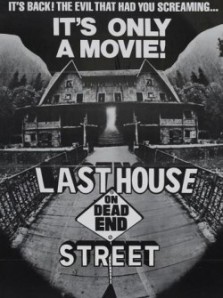
Roger Watkins' 1977 indie arthouse horror film has left behind a seared imprint on my mind since I first borrowed the Barrel release/double DVD from a good friend of mine back in 2004. I think the DVD itself had been released a year or two earlier... Since then, with Barrel's DVD having become woefully long out-of-print, I was able to find a different DVD copy quite easily (and cheaply) in the UK. Watching that film again, I was no less impressed than on the first viewing. There was something so rebellious, so fucking art, so bloody horrific in its low-budgetness... It was actually kind of profound in a way. Having been reminded of this flick in 2009, I began to wonder about the man behind the film. Roger Watkins. So I did what any slave to the kind of immediate self-satisfaction the internet generation has produced would do... I Googled him. And discovered forthwith that he'd died in 2007. Shame. But this was just the beginning of my curiosity, as it quickly piqued higher.

In Barrel's double-DVD there was also a booklet included where Roger Watkins (then going by the name Victor Janos) spoke about how the distribution company had literally - and physically - stolen the film (yes, the actual reels of film and negatives) from him back in '73. The film never appeared again until it's release by the shady distribution company in '77. Victor/Roger never even knew his film had been released (and re-titled) at all.

Also on this DVD is a special feature - the original episode of Joe Frankiln's talk show (originally aired on February 6, 1975) where Watkins speaks intelligently (though you get the sense he's high as a kite) along with his NY film prof about his movie, then titled "The Cuckoo Clocks of Hell". All of this had intrigued me back in 2004, but what I unearthed five years later only added to the mystique of Roger Watkins. I went looking for something, some films perhaps, or anything he'd done since the drug-addled Last House on Dead End Street. Well, here is a sample of what I found... Ultimately raising more questions than solving them, during the course of a day-long internet search that went from mysterious to enigmatically creepy. Judge for yourself.

From Wikipedia:
Last House on Dead End Street is a horror film released in 1977...
Few knew who actually directed the film, until Roger Watkins, who died in March 2007, posted on Internet message boards three decades after it was made saying he was behind it. The film was made in 1973, but was not released until four years later.
Watkins said he was high on amphetamines while making the film. He also said only about $800 was spent making the film, while the remaining $3,000 budgeted was used to buy drugs.
The film was virtually unavailable until Barrel Entertainment released a double-disc DVD in 2002. In the 1970s, its release was limited to grindhouse and drive-in theaters. The [original] version entitled The Cuckoo Clocks Of Hell ran some 175 minutes in length - though the only remaining print of it in that form is thought to be stored in a New York film lab.
Also From Wikipedia:
Roger Michael Watkins was a film director best known for the notorious 1970s movie Last House on Dead End Street He also directed several porn films. He worked with famous porn actors like Jamie Gillis and Vanessa del Rio.
And from Papermag.com:
"I was greatly distressed to hear of the passing of Roger Watkins, the director of the infamous cult classic Last House On Dead End Street on March 6 in Apalachin, N.Y. I saw that movie on 42nd Street and it really freaked me out at the time. The director’s name listed was “Victor Janos” (which was just a pseudonym for Watkins). Watkins was a director, author, editor and starred in the film as Terry Hawkins, just released from prison after a one year drug bust. Pissed off at the world, he rounds up a few friends and they decide to direct some films aimed at a “specialized” audience of degenerates. Actual snuff films, which they can make money from and get back at society with.
Watkins shot the movie after getting out of SUNY Oneonto college in 1972. In an interview he said there was $3,000 for the shoot but only $800 was used on the movie. The rest “I think it was to buy drugs,” he said. “I didn’t spend anything on that film.” It’s original title was The Cuckoo Clocks Of Hell (a reference from Kurt Vonnegut’s Mother Night). After it was finished it went through many shady distributors and didn’t hit theaters until 1977 as: The Fun House and later: Last House On Dead End Street, tying it into the Last House On The Left popularity. But as a film it still manages to unsettle -- it’s a nihilistic dark little horror masterpiece."

Some of the feedback from the Papermag obituary went as follows:

Elizabeth Watkins: "I am Roger's oldest daughter and I want to thank you for posting this article and paying tribute to him. I really miss him. He was the smartest guy I've ever met..."
Jo C. Schwarz: "Elizabeth, I am an old friend of your dad. I am sadden by the news of his passing. Roger was the smartest man I have ever met myself. His wit and charm will sorely be missed. He often talk about how smart you were as well."
Bob Arturi: "Elizabeth I had the pleasure of working with your dad at Bill Kolb Ford in Blauvelt, New York. He was one of the wittiest, smartest people I ever met. I lost contact with him for a while after he left the busines, but found him a little later at another dealership. He then totally left the business to move upstate and I didn't have the opportunity to speak with him before he passed away. I can't say enough good things about him, his sense of humor, our long conversations about his life in the cinema world, and of course his tales of his family. He will always be in my thoughts."
Barry Koch: "Elizabeth, Your Dad roomed at my house for a while back in the late 1980s. He was a brilliant, creative, and maddeningly mercurial human being... and remains unforgettable to those who knew him in to any degree. Despite the tempests that seemed to swirl about his restless mind, he always spoke lovingly of "his girls", you and your sister.
pedobear: "I loved roger too we hung out together looking for young girls. i will miss you. Pedophilia died with you. R.I.H"
ananymous: "Pedobear,  It is very important that I speak with you. You hold the key to a very important puzzle.  Please, please, please email me at this address. commentsemailatgmail.com. I will make it worth your while."
You can read the entire string of messages left behind at Papermag's obit here.

Sunday, September 02, 2018

3 Books a Month – August (Summer Reading)


At first, I thought I wasn't going to meet the challenge this month! (For those new to this, my wife Nicki and have currently have a three-books-a-month challenge taking place – indefinitely. It started in June). However, I actually passed the goal quite literally (ha!) in the eleventh hour on the 31st – of course, if you were to ask Nicki about it, she;d tell you that my last book didn't count. More on that later. So, the reason I almost didn't make the goal this August was actually in part the fault of the first book I'd read – Joe R. Lansdale's “The Thicket”. I've always loved Lansdale's work, though he's one of my favourite authors whose books I seem to only get around to every couple of years (I've really gotta change that, there are still a few of his early ones I haven't gotten to yet) – but hands-down, “The Thicket” is now my favourite Lansdale book. It's a Western-type of seek-and-revenge tale, with a Southern existential weirdness that really only Lansdale can do justice to (especially as he practically invented this style). This one is definitely the pick of the month. Following this, I absolutely devoured Stephen King's latest, “The Outsider”. And as much as I loved this book and the insane plot turns it took following the arrest of a child-killer who may or may not be innocent, and who was widely adored in his own community, I have to admit I was slightly annoyed (only slightly, mind you) as I was getting to the finale of the novel only to realize that there was a reliance on characters introduced earlier in King's “Mr. Mercedes” trilogy, which I had/have not read yet. Minor thing, though, but I'm a little OCD (just ask Nicki) and so I would've liked to have known that beforehand, and I might've read Mr. Mercedes first. At any rate, “The Outsider” is still very much recommend.
Finishing this novel was where the trouble began – I was dying to go back to something Lansdale-esque. But instead of reading another book, I launched into the Preacher television series on Amazon Prime and binge-watched the first two seasons. (I would've done three, but the third season wasn't available yet. Which might've been a good thing). As I ran out of Preacher episodes to gorge myself on, I remembered that back when I was experimenting with getting into graphic novels, I had actually purchased a Preacher book – Volume 4, “Ancient History”. I honestly couldn't tell you how long I'd held onto that graphic novel for, having purchased it years ago from Golden Age Comics on Granville Street. I can tell you that it had been stuffed to the back of the top shelf of the bedroom closet, and at one in the morning it wasn't going to go over really well if I woke Nicki up digging through my back-issues of The Walking Dead and Marvel Zombies to find this fucking thing, so I gave up after a cursory glance. Instead, I went for a trade paperback that my friend Vincent Ternida had given us a few days earlier – it was, in fact, his
first published novel. “The Seven Muses of Harry Salcedo” regards the trials and tribulations of singles-dating in Vancouver, told from Vincent's keen eye on Vancouver living and getting through a daily grind in what is often a schizophrenic city, even for people who were born here. His observations on the city are humorously perfect (the description of his “Java Mausoleum” in the first chapter instantly reminded me of the time I saw two young women carrying a new espresso machine to the cashier in the downtown Best Buy while both of them were carrying Venti Starbucks coffee beverages); and the description of Harry's dating life are colorfully painted with his uncannily acute sardonic/loving descriptions of culture in the city. As I actually managed to finish my friend's first novel before the
end of August, I found myself with one day to spare, so I did dig out the Preacher graphic novel (in the daytime, as to not find myself in the same predicament as two nights earlier), and finished it off on the 31
st. Although Nicki will maintain that “comics don't count” (okay, I might be paraphrasing there), I disagree when said comic is over 200 pages and boasts a lot of text and the stylized writing of Garth Ennis. “Ancient History” was mostly filmed in the first two seasons of Preacher, but I have to say that it temporarily satisfied my newfound addiction and gave me a new-found appreciation for the original graphic novels. Now all I have to do is track down the other eight books from the original saga... 

--V. 

RE-POST SERIES: THE SEVERED ARM!

(This "Re-Post Series" is a re-introduction of older writings created for a now-defunct blog from 2011. Still some interesting stuff, though! Beware, some of the old links may or may not still work).

So I was at my pal and co-producer Peter Speers’ place yesterday picking up the final video exports of our recent double-feature, when I’m snooping across his bookshelves and I come across a DVD titled “The Severed Arm” from 1973. Now, this DVD wasn’t exactly out in the open. It had been packaged in the cheapest of cheapest slip-covers (actually it was more of a Photoshopped envelope) and had been squeezed in between “Dawn of the Dead” and “Matchstick Men” and I assume completely forgotten about. It was still shrink-wrapped! According to Peter and his girlfriend Jen, neither of them had any clue as to how that DVD had gotten there on their bookshelf. The package promised gory cannibalism and some kick-ass revenge, while on the front of the envelope there was a picture of a hand that likely had no part in the actual film whatsoever with the tagline: “The right hand doesn’t know what the left hand is doing!”. So of course, we watched it.

Turns out this DVD was distributed by some company called “Dollar DVD”. I assume it had cost a dollar, but there was no price tag on it, even though it was still wrapped. So we throw it into the DVD player, and The Severed Arm starts off in a dimly-lit morgue, where some disguised antagonist saws the arm off of a corpse and then sends it out “Special Delivery” (not kidding – that’s what the package actually said) through the US postal service to our protagonist. From there, it’s pretty much a tedious 85 minutes showing us a complete lack of gore, horror, suspense, competent acting, and for the most part even a heavy lack of exploitation, until we (finally) get to the end, where there’s a lame-ass twist (the killer isn’t who we thought it was, it was somebody you never even knew existed!) coupled with a pretty good revenge twist… if only we got to see it, that is, instead of simply listening to the characters talk about it.

Well, the beer helped, that was for sure. The only fun part was watching it with a couple of friends, and I suppose that’s what these flicks are all about, anyway (although back in ’73 I assume we would’ve been watching it at the drive-in). Still, I wondered who was responsible for this schlock? Some of the credits at the end of the film seemed made-up, but I can’t be certain. Apparently the director also made a movie called “Coed Dorm”. Not much else to go on.

Till the next one, then…
-Vince

Sunday, August 26, 2018

Vertigo/De Palma - Part VI

* * * Part VI (The Scream/End Credits)***

Femme Fatale was the first real-feeling DePalma film I'd seen in the cinema. I had actually seen Carlito's Way and Snake Eyes in the cinema as well, but Femme Fatale was the first DePalma theatrical experience where I felt I was watching a film that could've been made during the time of his master trilogy of the early 80s. Femme Fatale was the extension of Dressed to Kill, Blow Out, and Body Double that it seemed Raising Cain had hoped to be in the 90s. Perhaps Raising Cain would have been more secured in that creative extension had DePalma been able to figure our how to edit the film in the manner that he'd originally envisioned. But with Femme Fatale, it was apparent that he had fully creative reign when it came to his experimental non-linear storytelling. Femme Fatale would be another revisiting of Vertigo themes while Raising Cain had served as a remake of DePalma's own Dressed to Kill, which of course, was a remake of Hitchcock's Psycho. Perhaps Raising Cain, then, would serve as a first offering of a post-1980s trilogy in and of itself, featuring Raising Cain, Femme Fatale, and finally Passion, which would also deal with the nightmarishly-presented ideas of Rachel McAdams having her own “double” that was haunting the thoughts and actions of Noomi Rapace. Indeed, the list of these six films undoubtedly make up the “key” and an importantly defining portion of DePalma's catalogue – Dressed to Kill, Blow Out, Body Double, Raising Cain, Femme Fatale, and Passion, which ironically (even if this was unintended) loops the modern idea of how society receives its modern media with the studio-television monitors, 16mm projected film, and newspapers of 1973's Sisters.
* * *

With all of its similarities, it was the final shot of Vertigo that really grabbed my attention and shook me out of my seat. It was the scream.

But twenty-four years before this, it was a television trailer for Carlito's Way (1993) that had grabbed my attention in a completely different fashion; it would be the first Brian DePalma movie I'd have the opportunity to see in the cinema ever and since discovering his films on VHS thanks to a handful of video rental stores in North Vancouver. My brother and I went to see Carlito's Way after it opened at what at the time was North Vancouver's only multi-screen cinema in an outdoor retail complex called Park & Tilford. Before the movie theatre opened there, Park & Tilford was a destination for families during the Christmas season because of the elaborate Christmas display of lights and decorations that were weaved through a monumental garden tunnel-path. And really, this was the only thing housed at the Park & Tilford location for years until the movie theatre went up, followed by a huge Canadian grocery store (Save-On-Foods) and soon afterwards, Blockbuster Video. I even rented Carlito's Way for a second and third viewing from this Blockbuster Video on latter occasions. Carlito's Way was really the epitome of flashback-sequence storytelling as the entire film was essentially one long flashback sequence.

The movie opens up with a shot of Al Pacino (“Carlito” in the film) being carried away, dying, on a paramedics' stretcher out of the tunnels of New York's Grand Central Station. The location immediately recalls the backdrop of important Blow Out scenes, including scenes leading up to the climax of that film. Even the reason that the two sets of leading characters from each of those two films are the same: they're catching a train out of town to hopefully outrun the bad guys. In the opening shots of Carlito's Way, we have DePalma telling us that it's the climax of Carlito's Way that is going to play out in the same locations. We also have him telling us, directly, the ultimate fate of his own leading character, and then invites us to find out if he was lying to us or not; taking us through two and a half hours of Carlito's flashback story. After the opening credits play out, with Carlito lifted from the train platform and transported away on an ambulance gurney, we see him a few months previous to this in a courtroom as his prison sentence has just been revoked due to illegal wire-tapping by the District Attorney, and so right away, we get another Blow Out reference, or at the very least another gentle reminder of that film. Again, hidden wires, microphones, and audio recordings play a minor but significant role in this film as well. The circling camera shot around Pacino and his love interest Penelope Ann Miller midway through the film reminds us of the same shot midway through Body Double (nineteen years earlier). Much of DePalma's filmography holds up years and decades after-the-fact, Carlito's Way in particular seems to get better with age, crawling up on Martin Scorsese's GoodFellas as best gangster movie. In fact, I believe one of the best scenes DePalma has ever film is the fight between Pacino and Miller, which takes place in her apartment – the two characters, arguing their own moral logic, remain separated by space, walls, and doorways until the argument reaches its heated moments – Pacino pushing his way into her bathroom, where Miller is standing, yet the two of them continue to argue without looking at each other, their heads are backside-to-backside. Finally breaking this disconnection that is coming between them, instead of looking directly at each other, they face each other in the bathroom mirror, where they are forced to face each other and themselves as slightly warped, opposite-reflections of themselves, until he finally breaks the mirror with his fist – cutting his hand. She follows him out of the apartment, like she would follow him later in her life, and she lets him go without her, as he would let her go without him at the end of the film, from the platform of Grand Central Station. Miller yells after him as Pacino disappears from her apartment: “I'm through cleaning up your blood!” – And she is through, she won't have to clean up his blood again, next time, the paramedics are going to do it for her. Unlike Nancy Allen's prostitute-with-brains-and-a-heart-of-gold character form Blow Out, Miller will get away from all the blood and crime that she'd been trapped in inside the city. Carlito's Way ends with her dancing in paradise.

Blow Out ends on a far more cynical note, made palatable only by the multi-layered irony that DePalma has brilliantly twisted it all into at the end of the story. Hitchcock himself had set-up a beautifully ironic twist at the end of his masterpiece Vertigo. At Vertigo's halfway point, as James Stewart has had to give up his ascent to the top of the bell tower, the last thing he hears is Novak's scream before the body falls, seemingly to its death, from the top of that tower. As the clues build up to a tense and wholly uncomfortable climax at the end of Vertigo, Stewart realizes that he had heard Novak's scream before seeing the body fall – only it wasn't her body. It was all a set-up to place Stewart as the only “witness” to another woman's “suicide” – all this an elaborate cover-up for the other woman's murder. As Stewart literally drags Novak back to the scene of the crime, he overcomes his crippling vertigo and manages to get them both up to the top of the bell tower, where the murder victim had been thrown. As they teeter on the edge of the tower, Novak, riddled with angst and anxiety, gets spooked by something in the shadows and accidentally falls to her death from the tower, her scream echoing once again for Stewart, but this time the scream isn't staged.

When DePalma's Blow Out opens up, we see John Travolta in a private screening room with the slasher b-movie producer, mixing the sound effects track for their horror movie. They are in need of a “good scream”. DePalma uses this detail of Travolta's background for some humourous scenes throughout the movie – as Travolta runs about the city trying to solve the apparent murder he's captured on his tape recorder, he's suddenly brought back into his everyday-world reality of having to test voice-over actresses in order to record the perfect scream for his producer. Still, they can't find the right one. The fact that the creepy villain-hitman of Blow Out (Lithgow) has ransacked Travolta's sound studio and erased every single recorded and meticulously catalogued sound-effect tape Travolta has ever created just puts him further back from ever being able to finish the work that his dayjob (and only source of money) requires. Throughout the entire film the circumstances surrounding Travolta's character only serve to push him further and further into a corner, until the climax of the film, where Travolta and Allen devise a plan to entrap the killer by wiring Allen with a hidden microphone – a plan that backfires fatally for Allen, and Travolta is left stranded and helpless, unable to help Allen as she screams harshly to her death through the headphones in Travolta's ears.

DePalma leaves us watching Travolta, in his own personal hell inside the private screening room with his b-movie producer, having to listen to Allen's death-screams over and over and over again; the only scream that he, the sound recordist, would have on tape in order that he could finally finish his job on the low-budget slasher film in front of him. That final scream would be the only thing John Travolta would walk away with by the end of that film, just like Novak's scream would be the only thing Stewart would walk away with, in spite of all his obsessions, at the end of his.

THE END
VERTIGO/DE PALMA by Vince D'Amato.
Copyright (c) 2017 by Vince D'Amato, All Rights Reserved. First published as an E-book, non-fiction, 2018. All photos are stock/promotional photos from their respective studios: Universal Studios (Vertigo), Warner Bros. (Femme Fatale), Warner Bros., MGM (Blow Out).

Sunday, August 12, 2018

Issue #70 - The Absolute Underground Papers

(Original text from Absolute Underground Issue #70 - originally published June, 2016)

“The Cinema Fantastique (Sex & Horror)”
by Vince D'Amato

I was recently in Netherworld Collectibles in Burnaby, BC, when I overheard a customer chatting with the proprietor and telling him, rather loudly so that most of the store could accidentally overhear him, that he “doesn't watch new horror movies at all because most of them seem really cool but they just disappoint”. Well, to be perfectly honest, this was a sentiment I shared for along time, until about a year and a half ago... One of the problems with new horror cinema was the perception that the genre itself was precipitating over its intended audience – new filmmakers were either pushing forth pretentious projection of their work that they considered high-brow, or to use the term some if these filmmakers were using five years ago, an “upper echelon” of horror cinema. Which basically meant cool-looking horror flick with no sex or nudity, which throughout the eighties and nineties had been required tropes for the genre, along with the blood, guts and scares. These “upper echelon” films, like House of the Devil, The Innkeepers, Mulberry Street, and to half this degree Your're Next, also barely delivered on the guts and gore aspect, usually saving such frivolities to the very end of their respective films (as I said, You're Next was somewhat of an exception, and as added bonus points it had Barbara Crampton in it!). On the flipside, if a horror fan did want a little nudity or eroticism included within his genre fare (artistically, of course), one would be forced to turn to the ridiculous – indie films like Call Girl of Cthulhu or the exploitive (and yet vapid) Hollywood remakes of the aforementioned 80s horror films. There was nowhere for us to turn to the seriously good side horror cinema that wasn't afraid to be sexy as hell as well...

In December last year I wrote my first Absolute Horror article; and the inspiration for that article had been the recent releases of independent horror films that had finally started to change the face of indie horror into something more sophisticated, more energetic, more suspenseful for audiences (such as myself) who have learned (i.e taught ourselves) not to rely on the studio PG-13 output for their morbid frights. We have been ushered into an era, by these new indie horror filmmakers, of films that may have originally been inspired by the likes of Friday the 13th or the films of John Carpenter, Wes Craven, and Sam Raimi, but films that nonetheless do not care to wear these influences outright on their sleeves – instead, these filmmakers are now often twisting and flipping the influences to such a degree as to design some very intense, visceral, and even darkly comedic low-budget scares. And they're pretty clever about it, too. And thanks to the critically and commercially successful Scarlett Johansson sci-fi horror/thriller Under the Skin and the hugely popular indie horror hit It Follows, we're starting to see a little sexiness reappearing in our horror fare – following these two commercial releases it seems to all be suddenly okay once again for a horror movie to be sexually aware, instead of pretending that people don't have it. (Meanwhile, Brain DePalma remained cemented in the gorgeously sexy slasher/thriller genre with his latest outing Passion, most criminally under-screened on this side of the world). But before we fully get back into sexy, allow me to talk about a very clever realization of the horror film that I came across about two days before writing this piece – a little film called The Last Shift which is an hallucinogenic mindfuck regarding a lone young female police rookie hired to guard a defunct police station the before it's permanently closed. It gets off to an edgy start and just gets totally intense from there, as our protagonist becomes trapped in the tomb-maze of the old station while running into some quite literal ghosts of the past who are hellbent on driving her insane. This small-scale horror flick calls up the intensity of the modern horror classic It Follows, as does new director Benjamin Moody's Last Girl Standing, which had its inspirational roots in the aforementioned Friday the 13th, but takes the idea of “the final girl” into dizzyingly outrageous and wholly intense territory. Last Girl Standing has been a festival hit in 2015 and 2016, and will be screening at this summer's Cinemafantastique Fest in Vancouver (July 8-10) along with some other amazing contemporary horror films that are far more steeped in the sexy, hallucinogenic, and the psychedelic: from the Burlesque-noir Cruel Tale of the Medicine Man and L.A. artist Anna Biller's erotic 60s throwback The Love Witch, to the erotic Lovecraft homage Harvest Lake (which incidentally is a far cry from Call Girl of Cthulhu). But the funnier side of genre cinema is also celebrated in b-movie maverick Ron Bonk's She Kills, and Canadian Ryan LaPlante's Holy Hell; and Hell Town – which is an astoundingly witty homage to Lynch's Twin Peaks. Alongside these films is the more intense Last Girl Standing and the neo-giallo The Red Man, but sexy does tend to reign supreme in this lineup, as it does with the collection of short films selected for the film fest also range from the off-the-wall bloodfest El Gigante (from Luchagore productions) to the very sexy First Love and Mistress C. The sexy and the funny (the bloody funny) collide in the French short Bitch, Popcorn & Blood. Indeed, the international collection of very sexy nightmares that populate this year's Cinemafantastique Fest are the films you're not apt to see at other film festivals on the west coast. With any luck, most of the films here will find some sort of distribution, but we're living in a funny time now when it comes to cinema culture. Hard media really is dying and has been niche for some time now. It opens up the opportunity for theatrical exhibition for films like these, but cinema has been crawling along towards a slow death, too, despite there being more film festivals in the world than any other time in history. Our venues are disappearing, and film festivals have dared to go digital, like the media itself. Despite this, there are die-hard cinema fans (like myself) who actively participate in the lumbering medium, who love to discover obscure on under-distributed gems. With horror filmmakers no longer settling for the easy low-budget go-tos of the zombie or vampire sub-genres, it is inspiring to see that so many independent genre films released over the last fifteen months have supplied us with some real, visceral thrills. So here's to filmmakers keeping the sexy, the erotic, the nudie-cutie, the fun, and the intense, in our serious – and darkly funny – horror cinema. Cheers!
(Cinemafantastique runs July 8-10, 2016 at the Norm Theatre at UBC)


Sunday, August 05, 2018

3 Books a Month – July (Summer Reading)


Happily continuing the three-books-a-month challenge, and getting halfway through some fantastic summer reading, I actually tried to be a little more ambitious than the three book-minimum and hit the four-book mark (proud as I was to have been able to do this last month) – alas, this was not meant to be – apparently, I was a hell of a lot busier in July than I was in June. Thinking back on this, I'm going to say this was true – at one point I found myself in over my head with a graphic design project while on a plane heading to a horror film festival – the very plane I was supposed to have been reading that elusive fourth book of the month. I decided at that point it would be alright to save the book for the flight back, the same flight in which the novel (Ian Banks' “The Wasp Factory”, if you're interested) wound up in the elastic-strapped back pouch of the seat in front of me while I watched Daddy's Home 2 all the way back to Vancouver; and despite even having a couple of hours to kill at LAX, most of that time was eaten up chatting with a couple from Philadelphia who had a ten-hour layover coming back back from a cruise. It was a nice chat, though. So, the three books I had managed to finish before that last week in July were my requisite three for the three-book challenge. The first book, “Cosmopolis” by Don DeLillo, was a fanatical and sexualized ride through the poetry of finances, global economic breakdown, and revenge. It was also a novel I had thoroughly wished that I had read a few years ago, before filming Odissea della Morte. The next one, a recommendation from last month's challenge, was Shirley Jackson's “We Have Always Lived in this Castle”, which turned out to be laced with unyielding philosophical insights into the good and the bad of human nature, and what, sardonically, might really be the actions behind what makes us “good”. This novel ended up being one of the best pieces of literature that I've read in a very long time. I had to return that one to the local library, but I'll be on the lookout for it now to purchase. The last of these three books was a Roberto Bolano book I'd found totally by fluke at the same library (and at the same time) I was returning the Shirley Jackson novel to – my eye caught it on the way out, and I picked it up before leaving the library; it was a Bolano book I'd never heard of before, “Una novelita Lumpen” – but reading it reminded me of how much I loved Bolano's “The Skating Rink” and “The Woes of the True Policeman”. “Una Novelita Lumpen” is a very quick read, and almost as good as “The Skating Rink”. It's bright and engaging and mysterious as it delves into the slightly enigmatic psyche of a young woman who, as a novice to sex and crime, ends up wildly involved in both. 


Sunday, July 15, 2018

Vertigo/DePalma - Part V

* * * Part V

As a cinephile, I have made it my business to collect as many films that I find intriguing, interesting, exciting, and engaging as I could find – the harder to find, the better the challenge. Such was the case with many of Dario Argento's films during my collecting in the 1990s, his films were continually hard (or nearly impossible) to come by until the advent of DVD around the turn of the millennium. Strangely, though, I was never compelled to collect DePalma's movies on VHS, in spite of my adoration for his work. Mostly, I would just rent and re-rent the VHS copies of Carrie, Blow Out, Body Double, Dressed to Kill, Carlito's Way, with only a couple of exceptions, which pertained only to his earlier films – Obsession was one of the VHS videotapes I was lucky to have come by on a shopping excursion to Bellingham, Washington; I'd found a copy of this movie in a VHS retail chain called Suncoast Motion Pictures. Obsession was one of DePalma's titles that I'd never been able to find up until that point, and so after making the purchase it would be the fist time I'd experience that thriller, which starred Genvieve Bujold, Cliff Robertson, and John Lithgow – with Bujold playing a dual-role as doubles. Obsession is DePalma's actually first stab at remaking Vertigo, with the first Bujold character having met her death in a firey car chasing following a botched kidnapping-for-ransom. Cliff Robertson's character then meets Bujold's younger double, fifteen years later, in an unlikely scenario in Florence, Italy. But this is once place DePalma shines as a storyteller – not only in making us believe in these unlikely coincidences, but in his ability to make us want to believe in them. There is actually something genuinely and inherently (and strangely, even innocently) romantic about DePalma's storytelling.

The other VHS tape I'd purchased was Sisters, thanks to that videostore owner who let me buy it right off of the rental shelf of his store. The third and last VHS tape I ever acquired of DePalma's catalogue was The Fury, and this videotape had been given to my by one of my sisters as a Christmas present one year in the late 90s.

* * *

The Fury (1978) marks a very intriguing spot in DePalma's overall catalogue, due to its cinematic content and its context within his filmography – it's a horror-thriller based on a popular horror novel of that time, and incorporates many of the virtuoso camera flourishes that would become the stylistic hallmark of his following films of the 80s. The Fury is essentially the bridge between DePalma's early horror adaptations (Carrie, from the Stephen King novel, and Phantom of the Paradise, a wild twist on “Phantom of the Opera”) and his trip of erotic-thriller masterpieces of the early 80s. The Fury expertly weaves and experiments further on the stylish cinematography and non-linear storytelling of his early thrillers Sisters and Obsession with the visceral energy and immediacy (paradoxically executed through long fluid shots and slow-motion camerawork) of his horror films, Carrie and The Phantom of the Paradox (the latter being more of a horror-thriller-musical in the style of, but superior to in this writer's opinion, The Rocky Horror Picture Show). This would all culminate in DePalma's unofficial Psycho remake, Dressed to Kill in 1980, the film that would really put DePalma on the map.

Although DePalma had toyed with placing media and media technology in his stories before the 1980s, with the television monitors and newspaper writers is Sisters and the series of slide-photographs that help to open the film Obsession, it wouldn't be until after Dressed to Kill that he would really start experimenting with ideas of incorporating all sorts of media and technology in his films. Of course, Blow Out featuring jon Travolta s our sound technician and hero was really the striking point for this, his subsequent Vertigo remake – Body Double – intriguingly toyed with the then-new videotape media that was just making its presence known in mainstream society, both in the consumer realm as well as the production realm. Following Wasson's first investigative moves through the Hollywood video rental store, he then manages to get himself hired onto an actual porn production in order to be able to meet with Melanie Griffith, the body double of the film's murder victim. DePalma takes us through the entire porn-scene production in one amazingly fluid set-piece that was: A) Aped by Quentin Tarantino for his celebrated Inglourious Basterds sequence that opens the fifth chapter of that film; and: B) Set to a pulse-pounding rock soundtrack that would serve as DePalma's foray into “rock video” territory, something that was in fashion within the Hollywood studios of that time. DePalma knew that he was basically shooting a rock video in service of this behind-the-scenes porn-movie sequence, making the entire scene a double-meta affair: A porn movie shot from behind-the-scenes as a rock video inside a movie that is about Hollywood b-movie and porn-movie actors, based on another movie from twenty-five years previous. Sound complex? It's not, because another one of Brian DePalma's brilliant talents is the ability to keep all of these overlapping meta-themes subtly riding the undercurrent of his actual story, about sex, voyeurism, and murder, without allowing these subtextual themes and secret criticisms of voyeuristic media to get in the way of his expertly stylized proceedings. Using a single word, DePalma basically has a firm grasp on his own cinematic style.

After DePalma would continue his stylistic approach to incorporating media tech into his films, with Raising Cain, Mission Impossible, Snake Eyes, and Femme Fatale, he would eventually twist the whole aspect of all of these films' opening sequences in his latest film Passion (2012), which would open up on a shot of the two lead heroines, both of whom are focused in on the screen of a MacBook laptop. For once, DePalma's camera is not showing us the images on the screen, instead, we're make to patiently sit while watching the two women (Rachel McAdams and Noomi Rapace) as they watch their shared computer screen (also sitting). We see only their faces and bodies and the back of the computer – they're the ones watching, and we don't know what they're watching, and it is never revealed, marking a first for a DePalma film. Soon, however, DePalma allows us to discover that McAdams and Rapace work for a mega-conglomerate media corporation in Europe. And sooner than later, iPhones, YouTube, security cameras, laptop cameras, and commercial media all quickly slither their way, extremely prominently, into DePalma's new take on the story of sexual and corporate power-plays, murder, and double-crosses and backstabbing while still managing to interweave the very importance of dream and nightmare sequences into his personal storytelling. If Passion is to be DePalma's last film, then he certainly went out at his peak, which is astounding unto itself considering his first notable step into the heavy-hitting cinema-auteur arena was Sisters, almost forty years before Passion was released. Sadly, Passion only received a limited theatrical release in North America, another signal of the changing media technology and the way popular media is delivered (and demanded) in society in 2012. The very way that iPhones/uploading/video-streaming marked the shift in Rapace's character's corporate power-position in Passion would wind up being the very reason that DePalma's brilliant thriller would receive very little attention in the cinemas and on hard-copy media distribution. It may have fared better with a VOD streaming release; but of course, watching a DePalma film on a Smart Phone is no way to watch a DePalma film at all...

(To be continued...)

Monday, July 09, 2018

3 Books a Month...

So, my lovely wife and business partner (Darkside Releasing, Cinemafantastique) Nicole (or Nicki, as she's called at home) proposed a literary challenge to me: reading three books per month, within the calendar months (so books started before the 1st don't count, nor do books finished after the 30th/31st). Tough! But doable, right? Stephen King claims to be a "slow reader" and yet he gets through around 80 books every year. 3 books per month is only 36 books a year. Easy peasy, Right? We tried to rope some of our other literate friends into joining this challenge with us, but even the booklovers that these friends our, our challenge was bet with immediate self-doubt. But then again, that is sort of the point of a challenge -- if it was easy, it wouldn't exactly be a challenge, then, would it?

I did make it through the first month, with 4 books, no less, and am on my way towards the July finish line. Here's what I got through (and thoroughly enjoyed, I should add, for all four of these titles), for the month of JUNE...


Thursday, June 07, 2018

The Mysteries of Donald Westlake's “Memory”


Donald E. Westlake might be best known as the author and creator of the hard-boiled Parker character that features in several literary and cinemaitc fictional outings. But a few years ago, a smaller publisher called Hard Case Crime published one of the author's missing, or . “never before published” works, entitled “Memory”.

Written in the 1950s, the plot concerns an up-and-coming stage actor who suddenly loses his functions for all faculties and facilitation of proper memory because of an attack by an angry husband, whose wife the actor had been having an affair with. The betrayed husband hits the actor over the head with a wooden chair, and the novel opens up in the hospital as the actor is awakening from this attack, only to find that he has lost every facet of his previously-working memory. He's lost his short-term memory, his long-term memory, and his ability to retain any memory past the near-present, unless he develops a fairly strict pattern of absolute repetition in his existence. This pattern has to be constantly supported with self-written notes and reminders through the underneath of the new daily routine. Donald Westlake then takes us on a four-hundred-plus-page journey through his lead character's existential nightmare; which for me, raised some skin-prickling philosophical questions, as well as a very big brain-nagging culture question...

The cultural question might not be what one might consider to be expected – in that my own question is actually relegated to something else that has popped up regarding Westlake's themes of memory loss, and to a great contribution to pop culture at that – through Christopher Nolan's breakout film, Memento. My question on this, where in Nolan's film his lead character suffers with the very same existential nightmare as that of Westlake's creation, is sort of a two-parter: Did Nolan somehow have the opportunity the claimed “never before published” manuscript, and was then able in incorporate many of these philosophical ideas of memory and existence into his own screenplay for Memento – or – are these questions just existentially inherent in any of us (like Christopher Nolan and/or Donald Westlake) for us to delve into if the notion ever occurs to us to ask?

My second question as to the mystery of Westlake's book, then, concerns the philosophy itself: Does existence actually really matter if we have no memory to use to incorporate, and in a sense, categorize (and even internalize), our own existence? With huge credit given toward Donald Westlake, he actually attempts to (and depending on your personal opinions, he does) answer these nearly mind-boggling questions. These are questions that stretch our imaginations, to be sure, as well as our own anxieties and nightmares about what it is to be a human being. The nearly heart-wrenching (yet surprisingly subtle and deeply meaningful) ending to Westlake's novel Memory might give most people answers to these philosophical questions, whether they wanted them or not – because the conclusion depends on if living in the present is exciting or horrifying, in your personal perspectives, which is what makes the entire novel, from page one, utterly riveting.

(The film, Memento...)


Sunday, June 03, 2018

MAXIMUM OVERDRIVE

In light of the next “Absolute Horror” column being published in the upcoming summer issue of Absolute Underground, where I chat for a while about one of my favourite authors Stephen King, I thought it might been fun to revisit this piece I wrote about his film, Maximum Overdrive, nearly seven years ago, which I'd always had fond memories of writing up for the UK website Videotape Swap Shop – which itself is now long since defunct.

The article was not as awesome nor as insightful as I'd remembered it to be. It's still a little fun, though. And I still hold a lot of gratitude for that now-gone website, VTSS, which was always quite supportive of my articles. (Huge thanks to Michael & Hannah)


MAXIMUM OVERDRIVE
by Vince D'Amato
(Originally published December 18, 2011)


Car movies, and especially their more-specific crossover cousin the car/road flicks, are something of specifically American cinema culture, having epitomized its heyday throughout the seventies. Coincidentally, this was also the decade Stephen King had his first novel published. And here's a man who has gleefully mixed America's obsession with the automobile as class status and bullet-fast horror and suspense throughout his career – with the likes of
Christine, From a Buick 8, Riding the Bullet, and Dolan's Cadillac just to name a few. When he made his movie deal in the mid-eighties with movie mogul-producer Dino De Laurentiis, It's really no wonder that King figured highways, trucks, and bloody horror would make for a killer directorial debut, and hand-picked his own short story, “Trucks”, as the key concept for his first (and subsequently only) self-directed adaptation of his own literary works.

The concept of King's original short story, which appears in the short story collection “Night Shift”, concerns a bunch of trucks that suddenly possess homicidal tendencies. In the film version, this happens after the earth is caught in the tail of a passing comet, trapping a bunch of truckers, diner staff, and a bible salesman inside the Dixie Boy Truck Stop Diner, with King here doing his best (or taking the piss?) while he tries to explain why the trucks went mental in the first place, something left out of the original short story, and something that is usually left out of his best works. King works incredibly confidently on the what is happening level, but in Maximum Overdrive, the why it's happening is almost gleefully far-fetched, even for a movie where machines suddenly get brains and start killing any humans they can't trap into becoming slaves. Speaking of which, how is it that the newlywed couple were able to keep control of their vehicle through all this...? Anyway...

With a pretty impressive cast including the reliable Pat Hingle (who easily steals the show), Emilio Estevez, Leon Rippy, Giancarlo Esposito (in one of his earliest minor roles), Lisa Simpson, and King's own discovery, Laura Harrington
(What's Eating Gilbert Grape), it's a shame King wasn't able to direct them with the same Americana satire that shines from the characters of his novels. Instead, everyone acts how HE acts in his films (see: CREEPSHOW); mainly, by over-acting to the point where the characters go beyond satire into Looney Tunes. Weirdly, though, this actually all sits pretty well with his over-the-top idea of seeing all the machines in the world suddenly going on a homicidal rampage, and compliments the outrageous style of the movie itself – and there are some truly funny moments, too. Meanwhile, all signs of subtlety are thrown out the window with within the first four seconds of the film, which nicely sets up what we're all in for as an audience.

And as if this weren't all legendary enough, King, ever the rock 'n' roll fan, hired none other than AC/DC to provide the screeching and hyper-catchy soundtrack. But what I want to know is how producer Dino De Laurentiis got King the rights to use the Green Goblin's head on the killer eighteen-wheeler toy delivery truck that's forever known as the cult mascot of this ridiculous but compulsively watchable cartoonish thrill ride. Okay, it's no
Shining or Shawshank or Mist or Pet Sematary, but King's cinematic creation has an ingrained warped sense of humor, and the satire does come shining through when the paper-thin walls of the mundaneness and routine of The American Way (circa 1986) come crashing down. Reading too much into this? Nah. It's awesome in its own unique way, it's a film I've watched a dozen times. It's like comfort food. Not really good for you, but damn it, there's just something so satisfying about it anyway. Then again, maybe it's just the exploding toilet paper truck, as if King is yelling at us from behind the camera: Heads up, you're in for a steaming pile of shit, and we're loving it!


Sunday, May 27, 2018

Vertigo/DePalma - IV

Part IV

...Another notable cinematographic trait from Vertigo [that DePalma utilized in his own films] was Novak's flashback whilst sitting alone in her bedroom. Here, the camera has framed the actress perfectly as she proceeds to write a note detailing her involvement in what we thought was her double's suicide up until now – where she admits, via her own voice-over and visualized for us (the audience) through a lengthy flashback of the bell tower scene, revealing visual information that we had not been privy to when the scene had originally played out earlier, that the “suicide” had been in fact a cover for murderous goings-ons. The mis-en-scene in the hotel room during the flashback brings to mind the excitingly framed flashback sequence from DePalma's The Fury when Amy Irving pauses halfway up an interior stairway and receives a psychic vision of her missing brother. DePalma shows us this vision as a split-screen as Irving remains frozen on the steps for us to witness her reacting to the vision – and while DePalma had played with dual-screen storytelling before in Sisters and The Phantom of the Paradise, he had never displayed it in this tricky and clever manner before – instead of the standard dividing line between the two scenes playing simultaneously, in The Fury, literally half of the backdrop surrounding Irving dissolves away into the vision she's having as the camera turns around her. Here, DePalma has displayed his most brilliant take on the dual-screen technique. The whole flashback trope also teeters over experimental territory, and although DePalma was no stranger to this form on non-linear storytelling, he wouldn't fully experiment with it until his later films, Raising Cain, wherein his seemingly overlapping flashbacks and dream sequences were viewed as too experimental for its time (1991) and DePalma succumbed to the pressure to re-cut his film into its current “theatrical release” version. Since that time, Raising Cain has been recut into a pseudo- “director's” cut where the scenes of real time, flashback, and dream fantasy have been restructured back into a form more closely resembling DePalma's original idea for Raising Cain. (This latter version is now available on a newer home video release). The epitome of DePalma's use of flashbacks had to have been his sophisticated, intricate, and suspenseful reveal of how and why Ethan Hunt's (Tom Cruise's) team of spies had been set-up and killed in the big-budget blockbuster Mission Impossible. This flashback sequence of DePalma's is particularly fantastic because as the sequence plays out as Tom Cruise's inner thoughts, mixing memory with gap-filling logic and circumstantial accusations, John Voight is sitting across from him simultaneously relaying a series of lies and his own false accusations, speaking while the flashback is occurring. The killing of the Mission Impossible team also happened in the first half hour of this exciting action film, literally and cinematically amping up the heroes-dying-halfway-through idea that had so intrigued Hitchcock in Vertigo and Psycho.

The ultimate experiment in non-linear storytelling for DePalma would happen a few years after Raising Cain and Mission Impossible. It would be the next decade, in fact, in 2002, when DePalma utilized a hugely extravagant flash-forward for the entire second act and continuing halfway through the third act of Femme Fatale, without even letting the audience in on it until the last few minutes of the film. At this point in his career, DePalma knew exactly how experimental he was being, he held no allusions that the climax of Femme Fatale might alienate his theatrical audiences. He was looking forward to the reaction that his film would get when it was released into cinemas.

DePalma's inspired fascination with both cinema and media serves to set up nearly every one of his key films in their opening frames. Sisters opens up with a shot on a broadcast television monitor. This was in 1973, and when DePalma returned to this idea of opening his films with televised monitors two decades later, he'd be nearly relentless with this idea. Raising Cain opens with a shot of a video baby monitor in a parents' bedroom. Mission Impossible with a shot of a live-camera monitor, monitored by a group of spies. DePalma had an obvious field day playing with interweaving video technology where a group of spies is pitted against two other groups of spies in the midst of double-crosses and doubleback twists – this is the very epitome of voyeurism quite literally blown out of proportion. In Snake Eyes, DePalma opens the camera shot on a series of new footage monitors until the camera reveals the live footage in actuality, without cutting. From this, the camera continues to weave expertly without any noticeable visual cuts for nearly the next twenty minutes, emulating Hitchcock's Rope once again as the camera follows a rowdy and rambunctious police detective played by Nicholas Cage and setting up the entire first act of the film, introducing all of the film's key ensemble players. Snake Eyes is DePalma's version of Rope on high-octane steroids. Instead of containing the fluid action to the interior of an apartment, DePalma's single-setting is an entire Las Vegas casino and hotel, his cameras gliding across casino monitors, down hallways, around a boxing ring auditorium and across the ceiling overlooking the insides of a row of hotel suites, all elaborately decorated in individual colour schemes. It's no wonder DePalma needed to hire Nicholas Cage for the role, at that time he might've been the only Hollywood actor up to the challenge of out-scene-ing the scenery. As for DePalma's key thriller trilogy of the 1980s, none of them started out with television monitors, instead, Dressed to Kill begins with an outright dream-fantasy seemingly disconnected to the rest of the film's reality, while Blow Out and Body Double both begin with the making of a b-moive, and both of those movies retain the making of the b-movies as their underlying sub-plots (both to be twisted in irony by the ends of those films). It is finally Femme Fatale (2002) that culminated and somewhat epitomizes DePalma's cinematic and media fetishes together – the opening shot, post-90s-DePalma, is of a television (going all the way back to Sisters), but this time the television is not displaying anything that is happening within the reality of the film, as the opening shots of monitors had done in every single past instance DePalma had utilized this technique – this time, the television is playing, appropriately, a scene form the classic Hollywood film noir Double Indemnity. Watching this film on television, we see as the camera fulls back, is a nude Rebecca Romijn, lying across a hotel bed. This is preamble to a diamond heist that is about to occur during a celebratory night at the Cannes Film Festival. This move fixes DePalma's own cinema with his passion for media and cinema, and these themes continue on through Femme Fatale as our other leading character, Antonio Banders, is introduced as a media photographer. Television, cinema, photography, and mass-marketing advertising all crossover each other with DePalma's trademarks: sex and crime. And like Vertigo, Rebecca Romijn takes over for an uncanny doppelganger (also played by Romijn) when the weaker double commits suicide. Not as much of a remake of Vertigo as Body Double is, DePalma's Femme Fatale regardless freely uses and twists around Hitchcock's plotpoints regarding the heroine and her double. The diamond-heisting Romijn, the stronger, more sexually outward and confident one, even gets involved with the dead double's love interest, just as Novak had done with Stewart in Vertigo. DePalma's Femme Fatale actually plays out like Vertigo from the heroine's point of veiw as opposed to the male point of view, up until the third act where DePalma's experimental intentions are finally revealed, pulling the rug out from under the audience.

(To be continued...)