
Monday, October 22, 2012

Friday, October 12, 2012
Finally... HD
 Just as corporate scientist are working hard to bring us SUPER-HD, Jess Franco gets some long-awaited notice on blu-ray... although the people at Twitch don't seen very impressed... "Redemption Films deal with Kino has produced a great number of gems ripe
for rediscovery, films that would never have made it to HD without the
clout of a venerable company like Kino behind them. The question now
becomes, is it really worth it?" I'd say of course it's worth it, for the simple fact that this prolific director already has a cult following. Is Twitch saying that becuase Franco's work is way outside of the mainstream that his fans don't deserve - or that, it really doesn't matter if they do - to see his work in the best presentation possible (that is to say, as close to a cinema experience as we're likely to get with Franco save for seeing a retrospective at a Parisian cinematheque every
Just as corporate scientist are working hard to bring us SUPER-HD, Jess Franco gets some long-awaited notice on blu-ray... although the people at Twitch don't seen very impressed... "Redemption Films deal with Kino has produced a great number of gems ripe
for rediscovery, films that would never have made it to HD without the
clout of a venerable company like Kino behind them. The question now
becomes, is it really worth it?" I'd say of course it's worth it, for the simple fact that this prolific director already has a cult following. Is Twitch saying that becuase Franco's work is way outside of the mainstream that his fans don't deserve - or that, it really doesn't matter if they do - to see his work in the best presentation possible (that is to say, as close to a cinema experience as we're likely to get with Franco save for seeing a retrospective at a Parisian cinematheque every  half-decade or so)? I'm just stoking the proverbial fire because, no, that's not what Twitch was saying, obviously, but I'd dare point out this lack of thought put forth in the brief blurb preceding the actual review of the Female Vampire blu-ray -- due out in just a few days. You can read about it here. And actually, it's a really good review, and I have to say I do agree with pretty much everything else post-blurb. Also, European retailer/distributor 1Kult has some hi-res Franco goodies this month, too... One thing Twitch did mention within the blurb in question that is obviously close to being right... the apocalypse does seem to be upon us now.
Check it out!
-V

Sunday, July 15, 2012
Brides of the Impalers
 When I got back from Europe earlier
this year the first thing I did was pick out Edward Lee's novel
Brides of the Impaler, which y wife had given to me as a
birthday present some time ago. I've always been a fan of the
frenzied writing of Lee's and his uber-sexualized Lovecraftian
fantasy-horror. But this time, I was in for something slightly
different. Opening to the Acknowledgments page, I was a little
surprised to see these names mentioned as the main inspirational
source for this novel: Jess Franco, Amando de Ossorio, Paul
Naschy, and Jean Rollin, “...whose macabre and brilliant films have
enthralled me for years and whose manipulation of imagery and
atmosphere have proven a polarizing influence.” Not only were
these filmmakers thanked, they were the first ones to be
thanked in the long list of appreciative credit. The book itself in a
contemporary, unique and highly energized twist on the Dracula
legends that sees The Nun appear in modern-day New York City,
recruiting ex-drug addicts/street girls into a supernatural order.
Filled with sacrificial implements, and general blood-splattering
(and again, heavily sexualized) mayhem this plot half plays out as a
police thriller (probably another nod to the Italian Poliziotteschi
flicks of the seventies) on top of the religious splatter-horror.
It's an awesome ride from author Lee, as usual, who penned one of my
all-time favorite novels (if you can find an old copy grab it!)
titled “The Coven”, from the early nineties, I believe.
When I got back from Europe earlier
this year the first thing I did was pick out Edward Lee's novel
Brides of the Impaler, which y wife had given to me as a
birthday present some time ago. I've always been a fan of the
frenzied writing of Lee's and his uber-sexualized Lovecraftian
fantasy-horror. But this time, I was in for something slightly
different. Opening to the Acknowledgments page, I was a little
surprised to see these names mentioned as the main inspirational
source for this novel: Jess Franco, Amando de Ossorio, Paul
Naschy, and Jean Rollin, “...whose macabre and brilliant films have
enthralled me for years and whose manipulation of imagery and
atmosphere have proven a polarizing influence.” Not only were
these filmmakers thanked, they were the first ones to be
thanked in the long list of appreciative credit. The book itself in a
contemporary, unique and highly energized twist on the Dracula
legends that sees The Nun appear in modern-day New York City,
recruiting ex-drug addicts/street girls into a supernatural order.
Filled with sacrificial implements, and general blood-splattering
(and again, heavily sexualized) mayhem this plot half plays out as a
police thriller (probably another nod to the Italian Poliziotteschi
flicks of the seventies) on top of the religious splatter-horror.
It's an awesome ride from author Lee, as usual, who penned one of my
all-time favorite novels (if you can find an old copy grab it!)
titled “The Coven”, from the early nineties, I believe.
While Lee may have been inspired by
this handful of creative genre-warping film directors, his novel
nevertheless is pure Lee, not really reminiscent of Franco or his
cinematic cohorts. No, for that I had to go back and revisit the
likes of Return of the Blind Dead (Ossorio) and Vampiros
Lesbos. Not that summer's back with us in full force I find my
thoughts swimming back to Soledad Miranda, Ewa Stromberg, Vampiros
Lesbos, and She Killed in Ecstasy. Although this cinematic
style is not exactly present in Lee's book, I can easily see how one
is inspired by all of this. There is something beautiful about the
cheap film stock and bright location shots of these stories, not to
mention the talent and charm in front of and behind the cameras,
which inevitably tends to bleed through.

And on yet another sad note, I'm
writing this on the day (one of my only mornings off all week) that
Sage Stallone was discovered to have passed away suddenly, a man who
unfortunately might me more known to people as the son of Sylvester
Stallone, but who actually co-founded the film company Grindhouse
Releasing and was responsible for bringing cinephiles films like
Fulci's The Beyond, Deodato's Cannibal Holocaust and
Lenzi's Cannibal Ferox to the North American DVD market. At
36, he's too soon gone on to join most of the above-mentioned
filmmakers and talented actors, RIP. --V

Tuesday, May 29, 2012
Finally - news from blu-ray.com

The Redemption label has confirmed that it is preparing to release on
Blu-ray various films by legendary Italian director Mario Bava. Exact
technical specs, region coding status and release dates are yet to be
confirmed, but the first titles are expected in September/October 2012.
The first batch of titles is expected to include Mario Bava's cult Mask of Satan a.k.a Black Sunday (1960), starring Barbara Steele, John Richardson and Andrea Checchi, Lisa and the Devil a.k.a The House of Exorcism (1974), starring Elke Sommer, Sylva Koscina, and Telly Savalas, and Hatchet for the Honeymoon a.k.a Blood Brides (1970), starring Dagmar Lassander, Laura Betti, and Stephen Forsyth (the latter coming from a new HD master).
The Redemption label has also confirmed that it will release on Blu-ray uncut versions of Jess Franco's Female Vampire a.k.a Erotic Kill (1973), starring the late Lina Romay, Jack Taylor and Alice Arno, Exorcism a.k.a The Sadist of Notre Dame (1979), starring Lina Romay and Catherine Lafferière, and A Virgin Among the Living Dead a.k.a Christine, Princess of Eroticism (1973), starring Christina von Blanc, Britt Nichols, Rosa Palomar, and Howard Vernon.
The first batch of titles is expected to include Mario Bava's cult Mask of Satan a.k.a Black Sunday (1960), starring Barbara Steele, John Richardson and Andrea Checchi, Lisa and the Devil a.k.a The House of Exorcism (1974), starring Elke Sommer, Sylva Koscina, and Telly Savalas, and Hatchet for the Honeymoon a.k.a Blood Brides (1970), starring Dagmar Lassander, Laura Betti, and Stephen Forsyth (the latter coming from a new HD master).
The Redemption label has also confirmed that it will release on Blu-ray uncut versions of Jess Franco's Female Vampire a.k.a Erotic Kill (1973), starring the late Lina Romay, Jack Taylor and Alice Arno, Exorcism a.k.a The Sadist of Notre Dame (1979), starring Lina Romay and Catherine Lafferière, and A Virgin Among the Living Dead a.k.a Christine, Princess of Eroticism (1973), starring Christina von Blanc, Britt Nichols, Rosa Palomar, and Howard Vernon.
Thursday, April 26, 2012

Tuesday, February 28, 2012
RIP Lina Romay, February 15, 2012

It's a shame, it seems like the internet news on Lina's death has been leaking slowly, I only heard about this today from a Mondo Macabro twitter post from the 24th - yet other sources are saying her actual date of death was nine days earlier than even that. She lost a battle with cancer, Jess Franco's life partner and muse. In his films, she was a force to be reckoned with whether playing a hard-ass femme fatale (or vampiric succubus, for that matter) or a mousy half-insane victim in his more atypical giallo-inspired sexploitation flicks. She worked with him far past her erotic due date, yet she was always a welcome presence in his films. And more than just that - she'd become an expected presence, part of Jes s Franco and his films. This is a sad reminder that as we get older we are bound to lose some of these inspirational performers and artists from this mortal coil, as we'll also go one day, but we will at least have her work, and her partner's work, to enjoy and be inspired by, influenced by, get drunk to, until our time comes as well. It just won't be the same knowing you're not around any longer, Lina. RIP.
 s Franco and his films. This is a sad reminder that as we get older we are bound to lose some of these inspirational performers and artists from this mortal coil, as we'll also go one day, but we will at least have her work, and her partner's work, to enjoy and be inspired by, influenced by, get drunk to, until our time comes as well. It just won't be the same knowing you're not around any longer, Lina. RIP.


Jean Rollin III
 I have not been, I'm sorry to say, in much of a Jess Franco state of mind lately. I've moved back from the UK and I was certainly glad to have access back top my stacks of retro Shriek Show and Blue Underground DVDs. Loads of Franco in there, that's for sure. Unfortunately, my limited leisure time on the DVD spinner has been filled more with the likes of John Carpenter, Brain DePalma and Umberto Lenzi (although the mannequins in Spasmo always reminded me of Franco's sixties masterpiece Succubus)
Apparently, the folks in charge of cult blu-ray distribution haven't had much of a mind on Franco, either, instead focusing on releasing the early stages of Jean Rollin's catalogue in glorious hi-def. It was sure nice to see these bad boys up in my Amazon recommendations...


If these discs do well in the face of the inevitable complete disappearance of the tangible media, more Rollin titles have been promised on blu-ray. Personally, as a collector, I'm both a little saddened and excited to think that this might be our last chance to own actual print copies of these, and many of our other favorite films.
-V.
Tuesday, January 03, 2012
The Escapees: or, a women-in-a-mental-asylum triple-feature
 It all started a few months ago when I had the opportunity to watch John Carpenter's new flick The Ward and it has come around to a little-known (to me, anyway) Jean Rollin flick called The Escapees, when I came across the Salvation UK DVD quite unintentionally in a little place off of Charing Cross Road in London. Not only was I not looking for this particular DVD, I actually had no idea the film even existed. I was intrigued, but not quite enough to delve into a blind purchase. Well, not immediately, anyway.
It was early this November when I saw Carpenter's The Ward, and it was a decent enough experience. After the disappointing Ghosts of Mars (his last actual feature film) and the completely unrecognizable-as-Carpenter Pro-Life, I went into The Ward with an understandable amount of trepidation. What was interesting, right off the bat, is that this is the first John Carpenter flick I can remember seeing that wasn't shot in Cinemascope. Nope, this sucker was 1.85:1. That seemed alright to me because the last thing of Carpenter's I'd seen and enjoyed was his Masters of Horror television episode Cigarette Burns, and what the opening scenes of The Ward felt like to me was that he was capturing the more intimate, smaller-aspect feeling of Masters of Horror. However, it did not end there... The story of The Ward is basically about a young woman (Amber Heard) who is committed to an insane asylum where some pretty strange goings-ons are transpiring amidst an alarmingly lengthening list of missing female patients. Set-up as a horror mystery, this turns out to be one of Carpenter's best films of recent times – certainly since the killer In the Mouth of Madness (which is, oddly enough, another flick about people going insane). There are some truly inspired scenes in The Ward, even evoking such Carpenter classics as The Thing and Halloween. However, before I get too carried away, The Ward won't be for everyone. Even as it evokes classic Carpenter is isn't classic Carpenter, it's an amiable enough effort that some people (myself excluded) might find predictable and somewhat by-the-numbers. I thought it was a good take on a
 classic Ten Little Indians scenario. Of course, the sub-plot of the film is leading lady Amber Heard trying to get the fuck out of there. Much like the opening premise of Jean Rollin's The Escapees...
And this is basically the only plot-thrust in Zack Snyder's otherwise completely plotless Sucker Punch, which I had the pleasure of viewing just this December. After reading some horrendous reviews of his first self-penned directorial effort, I steered clear of this sucker for ages. So what changed my mind? Well, that was thanks to discovering the existence of The Escapees, of course. I couldn't get it out of my head that this overblown Hollywood mega-budgeted film had essentially lifted the plot from a little old Jean Rollin flick from the early eighties. I'd say Snyder's flick is even more exploitive than Rollin's, at least Rollins has a gorgeous dreamlike narrative that swings it into the usual realm of arthouse fantasy. Snyder's film, for all its cold awesomeness, is pure exploitation fantasy as a handful of forgettably-written young female characters spend the entire film swinging from one reality to the next in order to ultimately escape the mental asylum they've all been committed to. It's a non-linear symphony of war machines, burlesque performances and fetishistic Bedlam narratives, intertwined with no real purpose other than eye candy. The film exists as a video-game puzzle, and while it is mostly cool to sit through, it's a puzzle that exists only because it is a puzzle (with eye candy), with no satisfying characters, plot or conclusion. In fact, the conclusion not only does not make sense, but it fails to justify the entire film. Still, I might give this one a second chance in the future. In the meantime, there area better things to experience...
 than Rollin's, at least Rollins has a gorgeous dreamlike narrative that swings it into the usual realm of arthouse fantasy. Snyder's film, for all its cold awesomeness, is pure exploitation fantasy as a handful of forgettably-written young female characters spend the entire film swinging from one reality to the next in order to ultimately escape the mental asylum they've all been committed to. It's a non-linear symphony of war machines, burlesque performances and fetishistic Bedlam narratives, intertwined with no real purpose other than eye candy. The film exists as a video-game puzzle, and while it is mostly cool to sit through, it's a puzzle that exists only because it is a puzzle (with eye candy), with no satisfying characters, plot or conclusion. In fact, the conclusion not only does not make sense, but it fails to justify the entire film. Still, I might give this one a second chance in the future. In the meantime, there area better things to experience...
 Like Rollin's film, where two girls committed to an asylum decide to escape. This actually happens pretty much immediately, so this isn't quite the girls-trapped-in-a-mental-asylum adventure I had been expecting. However, much like Rollin's earlier (and highly awesome) Requiem for a Vampire, this is a two-girls-on-the-run odyssey. After fleeing the asylum, they hook up with a band of traveling musicians/strippers who put on stripping road-shows behind railroad tracks. They eventually befriend some of the biker audience members, and the two girls, whose personalities clash and are extremely at odds when the road adventure begins, become friends. That's really it, there's not much more to say about this subtle, mature and surprisingly sweet story. The Escapees is not bizarre like Requiem for a Vampire, it's actually a straight-ahead road story about the two girls' growing friendship. In fact, there's barely even any nudity in this Rollin
  picture, and the brief scenes of sex are mild and non-exploitative, serving to contribute to the characters and the story. And in fact, this might be Rollin's best work. It's an engaging film and wonderfully shot. At nearly an hour and fifty minutes, one of Rollin's longer flicks (ignore the printed running time on the back of the Redemption DVD box 'cause it's wrong), the time really just flew by as I wallowed in the lushness of the movie. At the end, in true Rollin genre style, it does get wacky as a botched lesbian rape attempt (featuring Rollin regular babe Brigitte Lahaie) turns into an all out machine-gun shoot-out
 with an army of cops, and somehow, winds up with the two girls walking into the sunset. I'd have to say that this is probably the best acting I've ever seen in one of Rollin's films as well. I'd like to call The Escapees a minor gem, but to me, it's much more than minor. A hidden gem, or a criminally neglected gem, seemingly forgotten about in Rollin's usual catalogue of the fantastique. But a real gem. I urge Rollin fans to check it out.
-V.
Sunday, December 18, 2011
Behind Convent Walls

..Is Walerian Borowczyk's simple nunsploitation film worth writing about? What could I say that isn't going to be said better on the special features of the most recent DVD release (uncut from Nouveaux Pictures)? Well, nothing critical, really. But yes, the film is worth talking about, for several reasons, and there are things to say.
.
Something on the more interesting side of this erotic showpiece (besides the erotic showpieces, I mean) is the film's narrative structure, which for nearly the first two-thirds is purely nunsploitation, though arguably this is the fetishistic sub-genre at its finest. Because thankfully, Walerian Borowczyk is a master at cinematic eroticism; he knows what to shoot, how to shoot it, and has it play like true erotic cinema, never cheap pornography. He and Tinto Brass are probably the only two filmmakers with this deeply embedded talent of bringing charged sex to the cinema screen on such an affecting level, something to give Eyes Wide Shut a run for its money. Walerian's films are not slick, yet they have that same commercial quality that comes from talent rather than textbook, much like the early films of Scorsese or Romero. In fact, Behind Convent Walls even has a slight documentary feel to it, in spite of the fact that the last 40 minutes actually moves from its zone of sheer sexploitation to suddenly delve into a comic-book story of corruption, church politics, and Catholic repression, and that it seems a perfectly natural transition in Walerian's film, which makes it appear that this story shift had been the intention all along. Cinematically, much like Mean Streets or Martin, the film otherwise feels somewhat improvised.
Something on the more interesting side of this erotic showpiece (besides the erotic showpieces, I mean) is the film's narrative structure, which for nearly the first two-thirds is purely nunsploitation, though arguably this is the fetishistic sub-genre at its finest. Because thankfully, Walerian Borowczyk is a master at cinematic eroticism; he knows what to shoot, how to shoot it, and has it play like true erotic cinema, never cheap pornography. He and Tinto Brass are probably the only two filmmakers with this deeply embedded talent of bringing charged sex to the cinema screen on such an affecting level, something to give Eyes Wide Shut a run for its money. Walerian's films are not slick, yet they have that same commercial quality that comes from talent rather than textbook, much like the early films of Scorsese or Romero. In fact, Behind Convent Walls even has a slight documentary feel to it, in spite of the fact that the last 40 minutes actually moves from its zone of sheer sexploitation to suddenly delve into a comic-book story of corruption, church politics, and Catholic repression, and that it seems a perfectly natural transition in Walerian's film, which makes it appear that this story shift had been the intention all along. Cinematically, much like Mean Streets or Martin, the film otherwise feels somewhat improvised.
 At the end of the day, this film, like others of Walerian's and Brass', is really a joyous celebration of sex and the human condition. And as a storyteller, his feature films, like Convent or The Beast, are far more successful than when his talents are put out towards shorter anthology segments (as in Immoral Women). Borowczyk's talents shine in longer contexts, where as a filmmaker, his satirical voice is much more confident instead of purely jokey in his shorter narratives. Conversely, fellow erotic filmmaker Tinto Brass generally displays the opposite talent when it comes to narrative length.
The funny thing is that generally, when it comes to cinematic erotica, these aren't really the types of films that I bother to commit characters' names to mind. Either they stand out visually (The Frightened Woman) or they blend into the group shenanigans, and that is especially true here, where the story concerns an entire convent of nuns who are all dressed –or undressed— the same way. And what goes on behind those convent walls is slightly distracting, as well...
Much like The Beast (and even Immoral Women, which was a little too cutesy-poo for my liking) the erotica is true and beautifully handled, the camera movements in Convent specifically, while docu-esque, was handled by none over than the cinematographer of Suspiria, giving Walerian's film a gorgeous voyeuristic personality.
And speaking of gorgeous, check out this convent...(!) The beautiful nuns serve not only the film's eroticism, but manage to bring this flick into the realm of pure fantasy and nunsploitation while maintaining its verisimilitude, exactly where it wants to be.
.-V.
Friday, December 02, 2011
Lorna the Exorcist (1974)

Well, after some build-up, I finally had the chance to watch Jess Franco's Lorna: The Exorcist. Okay, now, where to start...? Perhaps I should mention – then again, perhaps it goes without saying – that there is nary an exorcist to be found in the film. Nor any attempt at an exorcism. There is a Lorna, however, and we first see her in a ten-minute lesbian romp with Franco muse Lina Romay (as Linda). We soon discover that this is some sort of lesbian fantasy on Linda's part, and as the plot thickens, we find that Lorna is capable of bodily possession. The first clue to this comes from the poor girl who spends the film half-naked in a hospital for the insane, locked in a room and watched over by a doctor played by none other than Jess Franco himself, in scenes that could have been lifted from a handful of other Franco films. The insane girl rants her nights away calling for Lorna. Lorna, we find out, has a direct connection to Linda and her parents in the film, and Lorna soon appears in the flesh to Linda (in yet another lesbian scenario, the third one between the pair at this point) while somehow placing a curse on Linda's mother. Lorna then doesn't so much jump from body  to body as she does lesbian encounter to lesbian encounter. And there is plenty of heterosexual scenarios, too, as Linda's father Patrick has more sex in twenty-five minutes than most of us have had all week. As watchable as all these shenanigans are, sadly, this is not one of Franco's more elegant nor graceful efforts. The camerawork is sloppy (okay, no surprise, right?) and the editing is just grating (again, not a big shock), but this is a real shame because Lorna (the film) boasts some of the finest locations Franco has ever filmed at, both exterior and interior. With more care, this could have been a gorgeous entry in the euro-smut genre, and possibly a minor gem. As it is, there are far too many technical distractions, even for a Franco film, as the subject matter, as well as the performances portraying the plot, are not nearly as charming or kitschy as some of his more famous efforts. That being said, the one thing that does make the film worthwhile is Lina Romay herself, who has rarely seemed more sensuous on screen. If nothing else, Franco certainly knows how to shoot a girl.
 to body as she does lesbian encounter to lesbian encounter. And there is plenty of heterosexual scenarios, too, as Linda's father Patrick has more sex in twenty-five minutes than most of us have had all week. As watchable as all these shenanigans are, sadly, this is not one of Franco's more elegant nor graceful efforts. The camerawork is sloppy (okay, no surprise, right?) and the editing is just grating (again, not a big shock), but this is a real shame because Lorna (the film) boasts some of the finest locations Franco has ever filmed at, both exterior and interior. With more care, this could have been a gorgeous entry in the euro-smut genre, and possibly a minor gem. As it is, there are far too many technical distractions, even for a Franco film, as the subject matter, as well as the performances portraying the plot, are not nearly as charming or kitschy as some of his more famous efforts. That being said, the one thing that does make the film worthwhile is Lina Romay herself, who has rarely seemed more sensuous on screen. If nothing else, Franco certainly knows how to shoot a girl.
-V

Tuesday, November 08, 2011
A Lady Above Suspicion, A Frightened Woman.
 About a week ago I went down to London's Roxy Bar & Screen for Filmbar 70's presentation of Forbidden Photos of a Lady Above Suspicion. Although I consider myself a fan of Luciano Ercoli's films, I had not seen this one in particular, despite having owned the Blue Underground DVD since 2006. This was one of those “lost in the collection:” titles. Strangely enough, I did bring a
  digital copy of it along with me to London this summer, but when I saw that Filmbar 70 would be hosting a big-screen presentation of this giallo, I saved my first viewing for this event. I was a little surprised to see actress Susan Scott (Nieves Navarro) take second fiddle in this arthouse-giallo, as she's the typical (if not the epitome) giallo female, and as I'd first seen her having lead roles in husband Luciano Ercoli's latter films, Death Walks at Midnight and
  Death Walks in High Heels. That being said, her role in Forbidden Photos is definitely striking and even, dare I say, slightly more memorable that Dagmar Lassander's lead performance (though she's pretty awesome, too), in this Lenzi-esque early giallo entry. The idea for Forbidden Photos relies on the trendy sixties-style Italio thrillers, where corrupt people try to drive each other insane with twisted, convoluted plots – films which were far more influenced by Les Diaboliques than any of the later gialli from the seventies, which focused more on sex and flamboyantly bloody murders (see again, Death Walks at Midnight). But even with the earlier giallo entry, Luciano Ercoli displays a profound flair for bringing in a cheap thriller disguised as stylish art, something that I'm coming to have more of an appreciation for each time I watch his films.
Strangely enough, I'd come across leading lady Dagmar Lassander a second time in as many weeks when I finally took a couple of hours to watch The Frightened Woman. On the surface (or rather, the DVD cover), Piero Schivazappa's film looks like a pseudo-psychedelic sixties sado-masochistic sex romp devoid of plot and drama. Boy, was I wrong. Sure, there's plenty of sexual (not sex) set-pieces and the entire design of the film is pretty effin' groovy, like Danger Diabolik if it had been designed for early Penthouse, but dammit if this film didn't  actually have a story, and it was sincerely engaging. Okay, so chalk this one up to the surprise of the week.
 actually have a story, and it was sincerely engaging. Okay, so chalk this one up to the surprise of the week.
I'm excited now to revisit, or discover, some of Dagmar's other works now that she's in the front of my mind. I must've seen her in Fulci's The Black Cat or Bava's Hatchet for a Honeymoon, but to see this Prague actress really kick some ass, you can't do better than Forbidden Photos and The Frightened Woman. Or possibly Werewolf Woman.
-V.
Wednesday, October 19, 2011
The cause of being erratic
I do have to apologize for the erratic (read: not too damn many) postings this summer, and now fall. It wasn't my fault! No, actually, it was my damn fault, I just wanted to say that while picturing John Belushi on his knees in a tunnel begging for his life to a pissed-off AK-47 swinging post-princess-leia Carrie Fisher. And if you have no idea what I'm talking about, then you likely need to sort that out immediately and quit reading this blog. Okay, for those of you still with me, again, my apologies. I intend to dedicate far more time to this blog in the coming months and to expand the dialog to some other filmmakers as I had with the Immoral Tales retrospective many moons ago. Upcoming, I'm intending a thorough re-examination of She Killed in Ecstasy and as well we'll have an exclusive look at Forbidden Photos of a Lady Above Suspicion as screened by Filmbar 70 at London's Roxy Bar & Screen. That's later this month. As for now, with Brivido Giallo, we're in the midst of principal photography on a new experimental Euro-thriller feature film, to be wrapped by November 5th and starting post-production later this year, or early January.
-V.
-V.
Thursday, September 08, 2011

Wednesday, August 24, 2011
Scala Forever season in London

Or: "A look at some London culture by someone from somewhere else".
In London, 2009, I was hunting around an HMV store when I found a Blu-ray release of Richard Stanley's "Hardware" I've always been strangely attracted to this film, something about it's post-punk, post-apocalyptic attitude, I guess. I didn't pick it up immediately as we were about to be heading back to Vancouver in a couple of weeks. I checked it out on the internet and found that Severin Films was set to release this gem a few months ahead, anyway, so I waited. (incidentally, this is one of the few titles I'd seen on VHS, and then was never able to track it down again until the Blu-ray release - totally skipping a whole media generation!) When I did finally get to watch Hardware again, I was excited all over again, it had been a long time. What was great was that Severin had also included a documentary on the days that Richard Stanley had worked at The Scala theatre at King's Cross in London. This was the first time I'd ever heard of it, and it seriously changed my life.
Unfortunaly, after this prompted some further wikipedia searching which unearthed some sad news. The Scala had never re-opened after a string of bad luck, starting with the suing by Warner Brothers at Stanley Kubrick's insistence, in 1993. Now it was just a night club.
 Two years later, June 2011: I find myself back in London. Somewhat indefinitely, I guess you could say. After six days of re-orienting myself, I made it down to the Roxy Bar & Screen where a couple of amiable fellas named Justin and Adam, who run the Filmbar 70 screenings in London, started chatting with me as I hung out at one of the tables outside the front doors on Borough High Street with a pint. Adam told me that they were going to be launching a massive six-week screening schedule for something that they were calling "Scala Forever". I knew what The Scala was, or had been, and I'd thought I'd heard him incorrectly, so I asked him if he could spell it while I made a note of it. S-C-A-L-A ..."Oh, Scala!?!" "Yeah," he said, "Scala Forever." I asked if The Scala had re-opened as a theatre, my voice surely filled with hope and excitement, and he told me no, that the screenings were in honour of the old Scala, which had indeed come to a finalizing demise in '93.
August 23, 2011: I went to my first of the Scala Screenings (the whole schedule is now about a week and a half in) and London writer David L Hayles was talking about the old experiences there, and his experiences with Russ Meyer. We were about to watch a double-feature of Meyer films, Mondo Topless and the classic post-sixties-culture-shocker Beyond the Valley of the Dolls. It was at this screening I met, for the second time only, a friend-of-a-friend named Tony. Turns out Tony used to run the Psychotronic store inside the old Scala and now has a store up in Camden, where you might be able to catch him once in a while. The man is a huge Jess Franco fan. He's been to Jess Franco's house, watching Franco's own flicks with him, and had dinner made for them by Lina Romay. He told me a lot of other stories, too, and with us both having an affinity for whacked-out sixties culture, we were able to quickly chat the time away until our other friends arrived and the screening began.
When I visit Tony and his Camden shop, at some point in the near future, I plan to give a full report on his seemingly immense collection of worldwide Jess Franco paraphernalia (depending on if I can get some good photographs or not). He's been collecting Franco's films since the 80's, and has acquired some strange titles on foreign videotape. These I would like to see!
But until then-- well, I don't know what. I'll try to survive more of the Scala Forever season. And I do mean survive. There are some screening sets that run from seven at night until eight the next morning. I'm going to give the 80's all-nighter a try.
-V.
In London, 2009, I was hunting around an HMV store when I found a Blu-ray release of Richard Stanley's "Hardware" I've always been strangely attracted to this film, something about it's post-punk, post-apocalyptic attitude, I guess. I didn't pick it up immediately as we were about to be heading back to Vancouver in a couple of weeks. I checked it out on the internet and found that Severin Films was set to release this gem a few months ahead, anyway, so I waited. (incidentally, this is one of the few titles I'd seen on VHS, and then was never able to track it down again until the Blu-ray release - totally skipping a whole media generation!) When I did finally get to watch Hardware again, I was excited all over again, it had been a long time. What was great was that Severin had also included a documentary on the days that Richard Stanley had worked at The Scala theatre at King's Cross in London. This was the first time I'd ever heard of it, and it seriously changed my life.
Unfortunaly, after this prompted some further wikipedia searching which unearthed some sad news. The Scala had never re-opened after a string of bad luck, starting with the suing by Warner Brothers at Stanley Kubrick's insistence, in 1993. Now it was just a night club.
 Two years later, June 2011: I find myself back in London. Somewhat indefinitely, I guess you could say. After six days of re-orienting myself, I made it down to the Roxy Bar & Screen where a couple of amiable fellas named Justin and Adam, who run the Filmbar 70 screenings in London, started chatting with me as I hung out at one of the tables outside the front doors on Borough High Street with a pint. Adam told me that they were going to be launching a massive six-week screening schedule for something that they were calling "Scala Forever". I knew what The Scala was, or had been, and I'd thought I'd heard him incorrectly, so I asked him if he could spell it while I made a note of it. S-C-A-L-A ..."Oh, Scala!?!" "Yeah," he said, "Scala Forever." I asked if The Scala had re-opened as a theatre, my voice surely filled with hope and excitement, and he told me no, that the screenings were in honour of the old Scala, which had indeed come to a finalizing demise in '93.
August 23, 2011: I went to my first of the Scala Screenings (the whole schedule is now about a week and a half in) and London writer David L Hayles was talking about the old experiences there, and his experiences with Russ Meyer. We were about to watch a double-feature of Meyer films, Mondo Topless and the classic post-sixties-culture-shocker Beyond the Valley of the Dolls. It was at this screening I met, for the second time only, a friend-of-a-friend named Tony. Turns out Tony used to run the Psychotronic store inside the old Scala and now has a store up in Camden, where you might be able to catch him once in a while. The man is a huge Jess Franco fan. He's been to Jess Franco's house, watching Franco's own flicks with him, and had dinner made for them by Lina Romay. He told me a lot of other stories, too, and with us both having an affinity for whacked-out sixties culture, we were able to quickly chat the time away until our other friends arrived and the screening began.
When I visit Tony and his Camden shop, at some point in the near future, I plan to give a full report on his seemingly immense collection of worldwide Jess Franco paraphernalia (depending on if I can get some good photographs or not). He's been collecting Franco's films since the 80's, and has acquired some strange titles on foreign videotape. These I would like to see!
But until then-- well, I don't know what. I'll try to survive more of the Scala Forever season. And I do mean survive. There are some screening sets that run from seven at night until eight the next morning. I'm going to give the 80's all-nighter a try.
-V.
Saturday, June 04, 2011
Necronomicon - Geträumte Sünden
 Yes, alright, this is a.k.a. “Succubus”, and I know I wrote about this flick upon my first re-discovery of it a few years back when Blue Underground re-released this sucker on DVD. If any Jess Franco film is primed to be re-released in HD it's this one. A lot of the cinematography is soft, but it's also lush. Actually, a lot of the photography in this film, right from the start of the opening credits (over various shots, some repeated, of various artworks), is pretty tongue-in-cheek. It's like a sexy psychedelic comedy of perversions.
After the artwork the first actual shot of the film is star Janine Reynaud in a sado-masochistic sexual performance set-piece (dressed in black vinyl whipping a semi-nude blonde strapped to a wooden X), something Franco would repeat several times throughout his career in the far more famous “Vampyros Lesbos”, and far more explicitly, in “Exorcism & Black Masses”. This may have been pretty controversial in the swingin' sixties (maybe) but it really just comes off as cutely-sexy now. Of course, the fact that the scene cuts away to an applauding audience just contributes to the fun side of this flick.
Janine Reynaud had a sexual androgynous look, but she's definitely filled with sex appeal. Jack Taylor walks in on her lounging on his couch:
“What are you doing here?”
“I was bored, so I came to your apartment, do you mind?”
“No.”
To which she then gyrates into a semi-tease dance in front of the record player. Pretty awesome. And she definitely had a set of legs on her. She can be a real heartstopper even when she's not actually taking her clothes off, and I know I've said this before, but Franco really knew how to shoot the best of his attractive actresses. His leading ladies were often (fuck that, ALWAYS) the best asset his films had. Even within the Ed Wood-esque “realism” of Franco's cinematic world, the leading actresses shone out like bright diamonds and gave most of his films a timeless charm. Reynaud does eventually disrobe, but then that's where the melodrama seems to start – while the movie retains it's initial tongue-in-cheek quality. Around this time (we're about 13 minutes in at this point) the film also veers off into its intercutting of beautifully soft psychedelic photography. Almost a cinematic rambling by Franco, it's nevertheless hard to peel the eyeballs away from the screen, thought it might be out of sheer campy curiosity as opposed to any kind of driving narrative, but that, what would one else expect? It's these sequences, actually, that really give Succubus a life and identity of its own, which is actually somewhat important for a film contained in a director's repertoire that is as vast as Franco's. Like Euginie De Sade, however, I feel like this movie would've benefited greatly from a driving soundtrack as opposed to the running voice-over narrative during these lengthy psychedelic sequences. But the, that might've been too artsy even for Franco. It's within this narrative we learn more of the association of the idea of the film to it's original title: Necronomicon. And while the film's original title in an obvious Lovecraft reference, leave it up to Franco to inject the idea of Marquis De Sade into his story, clearly making it more about the sexual than the satanic. (Yet there's even reference to Poe's works later on in the film).
In Succubus, Janine Reynaud seems like an all-in, assured, and confident actress exuding her hypnotic charm throughout, whether doing a strip tease, wandering through a psychedelic fog, or crawling around on the floor in the midst of a partly in her panties while the other guests intimidate her like a (literal) pack of crazy dogs. But she's also a commanding presence, easily commandeering the viewer's attention in spite of the terrible English over-dubbing and seemingly in the face of the film's sporadic overt cheesiness – or at least until we get two-thirds in where we get to some heavy and far-out Twilight Zone territory, with the requisite trippy/groovy soundscape. This is all sort of a Jess Franco allegory on the sixties drug/fear-of-drugs culture that was also portrayed in several American Roger Corman productions circa the same era. And amazingly, there's a shot at the hour-mark that's actually been aped by Luc Besson in “Subway”, and re-aped for Spielberg's “Minority Report”. Though I could never say with complete confidence this was at all intentional aping.
By the end of the film, we wind up back where we started (in a manner of speaking) with Janine Reynaud lying in Jack Taylor's pad, where he finds her sprawled out on some cushions following her psychedelic journey that may or may not have at some point turned homicidal. Succubus is actually quite a charming and clever little gem of a film.
Janine Reynaud is best known for this Franco film, as well as his “Two Undercover Angels” and “Kiss Me Monster” back-to-back female-Bond-esque kitschy comedies; and for Sergio Martino's “Case of the Scorpion's Tale”, and she appears to have quit acting somewhere around 1975-1978. There is a vague rumor that she had married an American millionaire and retired to Texas. Not much else is known about this sometimes stoic and always alluring talent.
Here's to you, Janine Reynaud! And to what is, for the moment, my favorite Franco film.
-V.

Monday, May 23, 2011
De Sade 2000
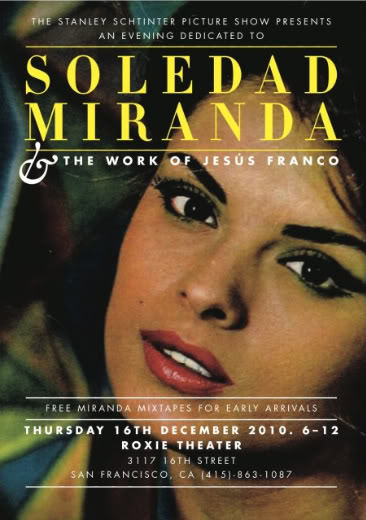
 With a title likely derived from Radley Metzger's Camille 2000, this vivid Franco opus is otherwise known as Eugenie De Sade. This film, along with Franco's She Killed in Ecstasy, are my tip-top two absolute favorites of the small cannon starring his first significant muse, the stunning Soledad Miranda.
De Sade 2000 / Eugenie Sex Happening / Eugenie De Sade opens up with a short lesbian scene involving Miranda, filmed in a brief series of gorgeous hand-held and somewhat candid-looking shots intended to emulate a kind of snuff film, which Franco, appearing here as an actor, is viewing in a private theater.
This is the opening to yet another Franco riff on the writings of the Marquis De Sade (which is evident even in the title). This time, the story is more straight-forward and nowhere near as meta-fictional as the earlier Eugenie... The Story of her Journey into Perversion (shot one year previously, in 1969). And this time, Franco wrote the screenplay himself. Somewhat unfortunately, however, in place of the former film's meta-fictional aspect we now get some stilted and slightly boring off-camera narration to help the cohesiveness of the story along, which is being told to Franco's character by Miranda's character in a flashback set-up while she lies dying in a hospital bed. It reminded me of the horrible Blade Runner voice-overs Harrison Ford had done in an effort to intentionally sabotage the whole narration idea. Yeesh. At any rate, the stilted narration is actually not much of a distraction as it's running over some beautiful exterior shots and the gorgeous Miranada, who is captivating both in and out of her clothes. She was a true gem in Franco's films, and his photographers (Manuel Merino this time) certainly knew how to shoot her – though I have a suspicion that filming Miranda was sort of like shooting exterior locations in Europe – it's kind of hard to take a bad shot. Now if only she had a better English voice-over actress.
 While the Miranda/Franco collaborations Vampyros Lesbos and The Devil Came from Akasava might be the more famous cult items, part of both of those films' infamy and popularity, I'm sure, are partly due to the rushed/cheap filmmaking and nearly inept editing that make them so-bad-they're-awesome pieces of kitsch. And without a doubt, the soundtracks to those films are the best in Franco's career. A jazz fanatic, Franco unfortunately used that inspiration only at sporadic moments in Eugenie De Sade (most overtly near the finale when the film intercuts to and from a jazz bar), this film is scored by Bruno Nicolai, who also scored Eugenie... The Story of Her Journey into Perversion & 99 Women in the sixties. I may have misworded something there, because Nicolai's score for De Sade is also awesome, especially during the third striptease/lesbian murder... it's just that... well, hell, it's no Vampires' Sound Incorporation.
Like “Lesbos”, this Franco outing revels in a type of excess only Franco could really achieve. Lurid, but not altogether sleazy, and there is plenty of nudity and what's been dubbed “soft-gore” by Christopher Null of filmcritic.com. Not as kitschy as “Lesbos”, “Akasava” or “She Killed in Ecstasy”, it's not nearly as inept, either, and in fact I'd say De Sade is one of Franco's most accomplished works of his entire career. Although that's not to say De Sade is not without a little kitsch of its own – check out the awesome nude photography/murder set piece thirty minutes in.
Franco plays a writer in this flick who tends to act more like a stalker, though that's not really unusual when it comes to his on-screen presence. Also creepy is Paul Muller, who plays Miranda's father and accomplice to the murders. At the end she lures one of the jazz musicians from the club, presumable for the final perfect murder, but she actually ends up becoming attached to the trumpet player – of course, all of this comes to a head in the midst of obsession and jealousy, and hence, Miranda's character winding up in a hospital bed. Obsession does play a significant role here, much as Franco himself was obsessed with the writings of Marquis De Sade since he'd started his cinematic career.
Eugenie De Sade was only one of six films Franco shot with Soledad Miranda in 1970 – a year in which he also directed three other non-Miranda projects. And while he would go on to find decades worth of inspiration through his next muse, Lina Romay, the Miranda projects seem like they will always be the focal point of his insanely prolific career, and I'd have to say, deservedly so.
-V.
Saturday, May 14, 2011
Eugenie... The Story of her Journey into Perversion
 Holy crap, how's that for a title? I'd say it's in competition alongside some of Sergio Martino's gialli from the seventies!
I started thinking about Franco again while planning the move to the London, something I'd read about the man years ago that had stuck with me – how he would often choose directing jobs based on the food in the region the project would be filming.* Yes, he allowed the food to be the deciding factor. And I say, completely without facetiousness, I believe he had his priorities straight off the bat. Although I'm not sure how far he traveled to shoot Eugenie, from what I've gathered from the trusty internet (okay, that was facetious) he shot this sucker around Barcelona. Of course, Franco being from Spain, I have a hunch he may have been familiar with the territory.
This tribute to Marquis De Sade's “Philosophy of the Bedroom” is a meta-fictional take on his work, where the characters refer not only to De Sade himself, but to his actual works of fiction within this work of fiction. Which is why I would lean more on calling it a tribute to his works, though from what I've read this story is closely based on the slightly absurd tongue-in-cheek style of his writings, much like Philip Kaufman's “Quills”.
This one stars one of my favorite cult/Fraco actresses, Maria Rohm, and she looks the best in this film. Never more stunning, though her on-screen vampiness was probably put to better use in “Venus in Furs”, the photography of her form and actions in Eugenie is some of the best. If not the best. But speaking of vampiness, I think to one of the set-up scenes in Euginie where she smacks her bitch-servant across the face, to which her co-star Jack Taylor asks, “Was that wise?” Rohm retorts: “You don't love me for my wisdom.”
Okay, maybe that called for a spoiler alert because that was pretty much the best line in the whole flick. The rest of Eugenie, as a film, pretty much relies completely on the lushly photographed women in various stages of nudity and sexual situations. And the term 'sexual situations', though a well-worn and thrown-around term of the MPAA's, was never more apt than in the context of a Marquis De Sade adaption.
Narrating some of these situations, during he more lurid goings-on (though the psycho/sado-sexuality is a bit lite by today's standards) is Christopher Lee, whose scenes weave the whole meta-fictional aspect through Eugenie's cinematic reality... and while he spouts De Sade soliloquy, there are naked women being stabbed on the same stage. (Yet in an on-screen interview present on the Blue Underground DVD, Lee claims to have had no knowledge of the content of this flick until he screened the finished product. I dunno... what exactly did he think he was watching from behind the curtain? And what about that girl who was getting on her knees in front of his--)
Anyway, as far as Franco's cannon goes, Eugenie has been one of my favorites for a long time now. As much as Franco seems to loath his own work, even he claims (again, on-screen) this Eugenie is the film of his that he hates the least. Trust me, it's at least better than that. But it doesn't surprise me that an artist would find his own work hard to take joy from, I've heard others say similar things about their own work. Sometime you have to look past the WIP flicks, as entertaining as they are, to see that Franco really was an artist at times. Eugenie was no accidental film, Franco has made many other films that boast lush photography and an intelligent sense of humour. And sometimes a dumb sense of humour, too. Personally, I think the fact we're still talking about these films decades later speaks for itself.
 On a side note, when I was looking up some info for this post, I inadvertently discovered that producer/writer Harry Alan Towers (who took credit under the pseudonym Peter Welbeck, the same name he used for 1975's And Then There Were None, which also co-starred his wife Maria Rohm) had passed away in the summer of 2009 in Canada – the same year Jess Franco won the Goya award (Spain) for Lifetime Achievement.
Harry Alan Towers also produced a few works for director Tobe Hooper later in their careers. One, which I hope to revisit soon, was Tobe Hooper's Night Terrors (again loosely based on De Sade) starring a young actress named Zoe Trilling, whose star, to my honest surprise, never really shot out.
*From the book Immoral Tales: European Sex & Horror Movies 1956-1984 (1994) by Cathal Tohill and Pete Tombs
-V.
Subscribe to:
Posts (Atom)


